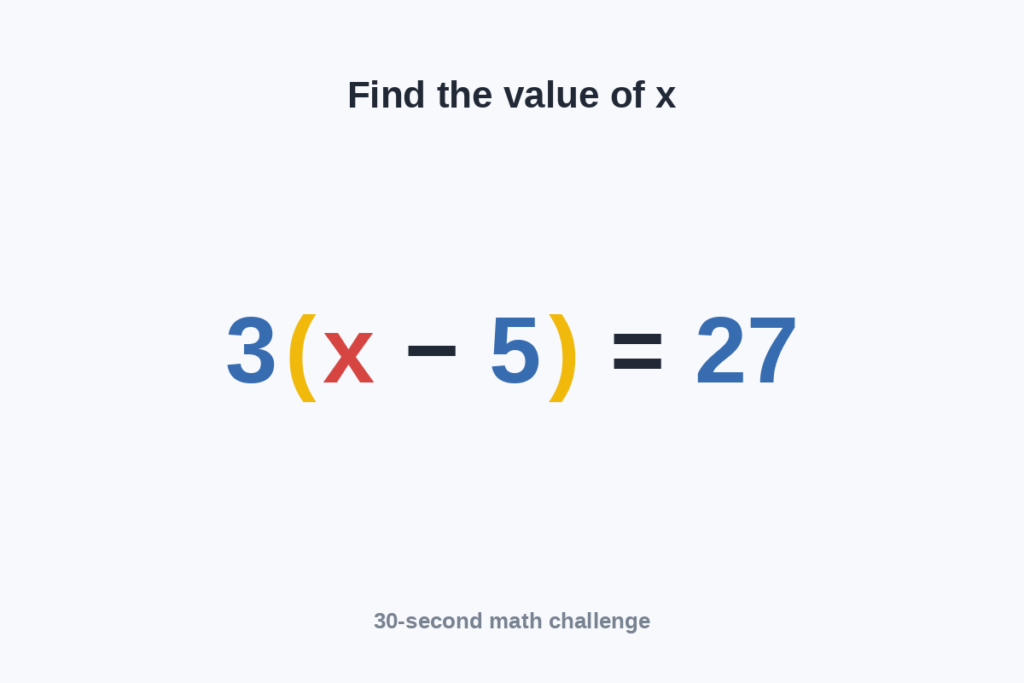
A single number in front of a parenthesis, a subtraction tucked inside, and a result of 27. This equation looks like homework, but it hides a small trap that catches more people than you would think. You have 30 seconds to find x.
Picture a student sitting in the back row of a math class, convinced that equations are simply not for them. Every new exercise feels like a wall, and every mistake seems to confirm the verdict. Then one day the teacher hands out a problem that looks intimidating at first glance, yet only takes two moves to solve. When the answer clicks, the student realizes something important: the problem was never that hard. The way of looking at it was.
That is the quiet power of algebra. It teaches us to break a situation into steps, to undo what has been done in the right order, and to keep going when the first attempt fails. The same habit of mind is used every day by engineers, doctors, architects and programmers, and it shows up in bridges, satellites and the software running on your phone.
It also drives some of the most remarkable careers in science. In 2014, the Iranian mathematician Maryam Mirzakhani became the first woman to receive the Fields Medal, one of the highest honors in mathematics, for her work on the geometry of curved surfaces. Her path is a reminder that great results usually start with a simple question and the patience to chase it. Today’s question is a lot smaller, but the method is the same.
The challenge
Here is everything you need:
- The unknown is the letter x
- The number 3 multiplies the whole parenthesis
- Inside the parenthesis, 5 is subtracted from x
- The result of the left side is 27
What is the value of x? You can start by getting rid of the multiplication or by expanding the parenthesis: both roads lead to the same place, as long as the rules are respected. Try it in your head, no calculator. The clock starts now: 30 seconds.
Quote of the day
“Young man, in mathematics you don’t understand things. You just get used to them.” This reply is attributed to John von Neumann, one of the great mathematicians of the 20th century. It is a comforting thought: an equation that feels strange today becomes second nature after a few repetitions. Practice builds the reflexes that let you spot the right method in a split second.
What this challenge trains
This puzzle works on first degree equations and on multiplying a whole parenthesis. It exercises distributivity, inverse operations and the art of isolating an unknown. It also sharpens concentration and the habit of checking a result, and it shows that the same equation can often be solved in more than one way, provided the basic rules of algebra are followed.
Step 1: read the structure of the equation
Before touching any number, look at how the equation is built. The 3 sits right in front of the parenthesis, with no sign in between. That means it multiplies everything inside: both x and the 5.
The goal is to isolate x, one layer at a time. The outermost layer is the multiplication by 3, so the fastest route is to remove it first.
Step 2: divide both sides by 3
Whatever you do to one side of an equation, you must do to the other. Dividing both sides by 3 keeps the balance intact while cancelling the multiplication on the left.
x − 5 = 9
The equation is now much friendlier. x is no longer multiplied by anything, it only has a subtraction attached to it.
Step 3: isolate x
x minus 5 equals 9. To undo a subtraction, add the same amount to both sides.
x = 14
Two moves, and x is found: x = 14. But a good solver never stops there.
Step 4: check the answer
Replace x with 14 in the original equation. If the reasoning is sound, the left side must give exactly 27.
3 × 9 = 27
27 = 27
The equality holds, so x = 14 is confirmed.
Step 5: a second route with distributivity
Instead of dividing first, you can expand the parenthesis. Distributivity says the 3 has to multiply each term inside: 3 times x, and 3 times −5.
3x − 15 = 27
Now add 15 to both sides to isolate the term containing x, then divide by 3.
3x = 42
x = 42 ÷ 3
x = 14
Same answer, different path. When two independent methods agree, you can be very confident in the result.
Step 6: the traps to avoid
The first trap is forgetting that the 3 multiplies the entire parenthesis. Someone who writes 3x − 5 = 27 instead of 3x − 15 = 27 will end up with a wrong value of x.
The second trap is using the wrong inverse operation. From x − 5 = 9, you must add 5 to both sides, not subtract it again. It sounds obvious, yet under a 30 second timer it is an easy slip.
The last trap is doing too much work. Expanding the parenthesis is perfectly valid, but simply dividing by 3 straight away was the shortcut that made this challenge solvable in a few seconds.
The answer: x = 14
Dividing both sides by 3 gives x − 5 = 9, and adding 5 gives x = 14. The check confirms it: 3 × (14 − 5) = 3 × 9 = 27.
Small steps beat big obstacles
An equation that looks impressive at first can often be solved with a couple of basic operations, as long as you take a moment to read its structure. Divide, add, check: that is the whole recipe here. The same approach works far beyond math class, whenever you need to untangle a problem, make a decision or plan a project one step at a time.
So, did you find x = 14 before the 30 seconds ran out? If you did, well done. If not, keep the method in mind: spot the parenthesis, simplify, isolate the unknown, then verify. Repeat it a few times and, as von Neumann suggested, you will simply get used to it.