
Three drivers leave at exactly the same moment, each heading for the same village on the far side of a mountain. One takes a long scenic road, one takes the short direct route, and the third picks a winding road where he can drive much faster. All three are sure they made the smart choice, but only one car will reach the finish first.
At a glance, the obvious answer is the car on the shortest road. But a short road driven slowly can easily lose to a longer road driven fast. To settle this race, you cannot just look at the map: you need the link between distance, speed and time.
That is exactly the kind of situation where a few lines of arithmetic beat gut feeling. Sailors crossing oceans, astronomers predicting the motion of planets and engineers planning roads and railways have all leaned on the same simple relationship. Today, every GPS estimate of your arrival time is built on it too.
Picture two friends about to drive to the same family dinner. One chooses a much longer route because it “feels” quicker. The other takes a shorter road known for crawling traffic. They argue about who will arrive first and never agree, until they compare distances and speeds and realize that one small equation answers the question for them. Today’s challenge works the same way.
The challenge
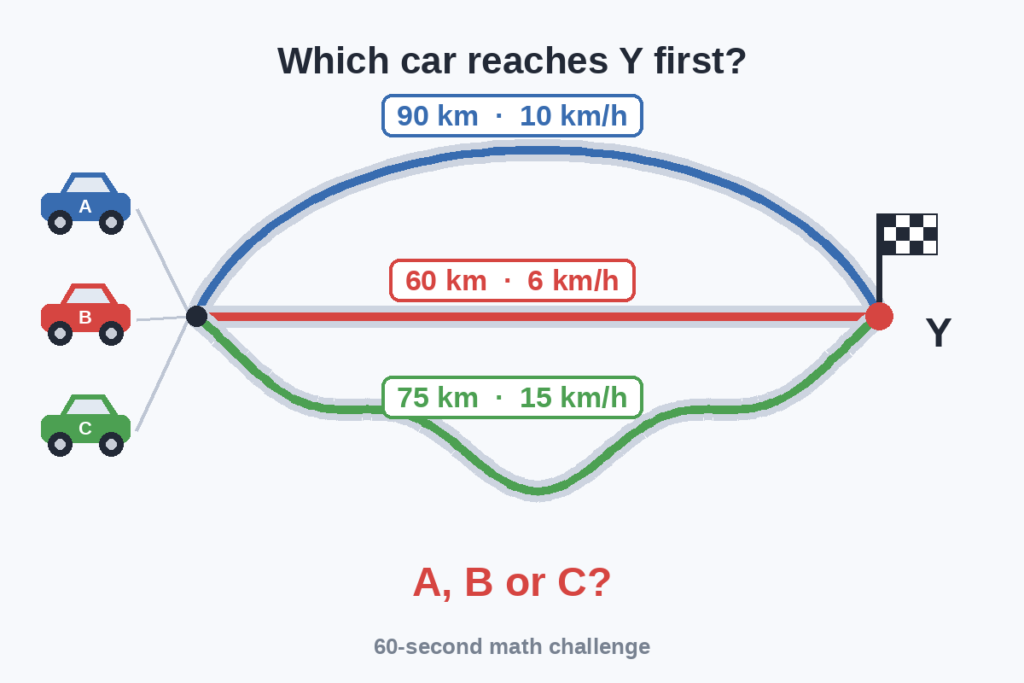
Three cars, A, B and C, start at the same time and must all reach a finish point called Y. Each one follows its own road, with its own distance and its own constant speed. Your mission: find out which car gets to Y first.
- Car A (upper road): 90 km at 10 km/h
- Car B (middle road, the shortest): 60 km at 6 km/h
- Car C (lower winding road): 75 km at 15 km/h
Car B looks like the favorite because its road is the shortest. Car C drives much faster, but its road is a bit longer. Car A sits in between on speed, yet faces the longest trip of all. So, A, B or C?
You have 60 seconds. No calculator, just your head. The clock starts now!
60… 50… 40… 30… 20… 10… 5, 4, 3, 2, 1… Time is up!
A word from Galileo
Galileo wrote in The Assayer (1623) that the great book of the universe “is written in the language of mathematics”. Whether we are tracking planets or a car on a mountain road, numbers are how we turn what we see into something we can actually measure and compare. Today we use that language on a simple question of speed and distance.
What this challenge trains
This puzzle asks you to compare several trips that differ both in length and in speed, which is exactly where intuition tends to slip. It trains you to use the core relationship between distance, speed and time, sharpens your mental division, keeps you careful with units and, above all, pushes you to calculate before you answer instead of trusting the first impression.
How did you do?
- Right answer, fast: excellent logic and strong analytical reflexes.
- Right answer after some thought: you know how to structure your reasoning and check each step.
- Wrong answer or no answer: no problem, this type of puzzle is a great way to build method and precision.
Step 1: the formula that decides the race
We already know every distance and every speed. The only missing piece is how long each trip takes. Since all three cars leave together, the winner is simply the car with the shortest travel time. That time comes from one formula:
With distances in kilometers and speeds in kilometers per hour, the result comes out in hours. Let’s apply it to each car.
Step 2: travel time for car A
Car A takes the upper road: 90 km at a steady 10 km/h.
Time A = 9 hours
Car A needs 9 hours to reach Y. That gives us a first benchmark.
Step 3: travel time for car B
Car B drives the shortest road, only 60 km, which sounds like a big advantage. The catch is its speed: just 6 km/h.
Time B = 10 hours
Despite the shortest road, car B needs 10 hours, one hour more than car A. This is the first proof that comparing distances alone gives the wrong answer.
Step 4: travel time for car C
Car C follows the winding lower road: 75 km, longer than B’s route but shorter than A’s. Its advantage is speed, 15 km/h.
Time C = 5 hours
Car C reaches Y in only 5 hours, far ahead of the other two.
Step 5: compare the three times
Car B: 10 hours
Car C: 5 hours
Car C has the shortest time by far. It arrives 4 hours before car A and 5 hours before car B.
Step 6: check the results the other way around
To make sure nothing slipped, flip the formula and rebuild each distance from speed and time:
Car A: 10 × 9 = 90 km
Car B: 6 × 10 = 60 km
Car C: 15 × 5 = 75 km
We get back exactly the three distances of the puzzle, so the travel times are correct.
The two traps hidden in this race
The first trap is assuming the shortest road wins. It feels logical, but it ignores speed completely, and here it actually picks the car that finishes last.
The second trap is more subtle: picking the fastest car without doing any math. In this puzzle it happens to land on the right answer, but only by luck. A very fast car can still lose if its road is much longer. The only reliable method is to calculate the time of every trip and compare those times.
Final answer: car C wins
Car C covers 75 km at a constant 15 km/h and reaches Y in just 5 hours. Car A follows after 9 hours, and car B comes in last after 10 hours.
- First place: car C, 5 hours
- Second place: car A, 9 hours
- Third place: car B, 10 hours
Looking past appearances
Car B seemed to hold the winning ticket with the shortest road, yet its low speed dropped it to last place. Car C won thanks to a better balance between how far it had to go and how fast it could get there. The same logic shows up every time you plan a trip, pick a route or estimate when you will arrive.
No complicated math was needed here: one simple formula, applied carefully, was enough to rank three situations that looked hard to compare. Did you name car C before the 60 seconds ran out? If you picked another car, keep this rule in mind: to compare trips, compare their times, never just their distances or their speeds.