One panda, two tree stumps of the same size and just two measurements. With nothing else to go on, can you work out how tall the panda really is? You have 30 seconds, and one of the two numbers is not what it seems.
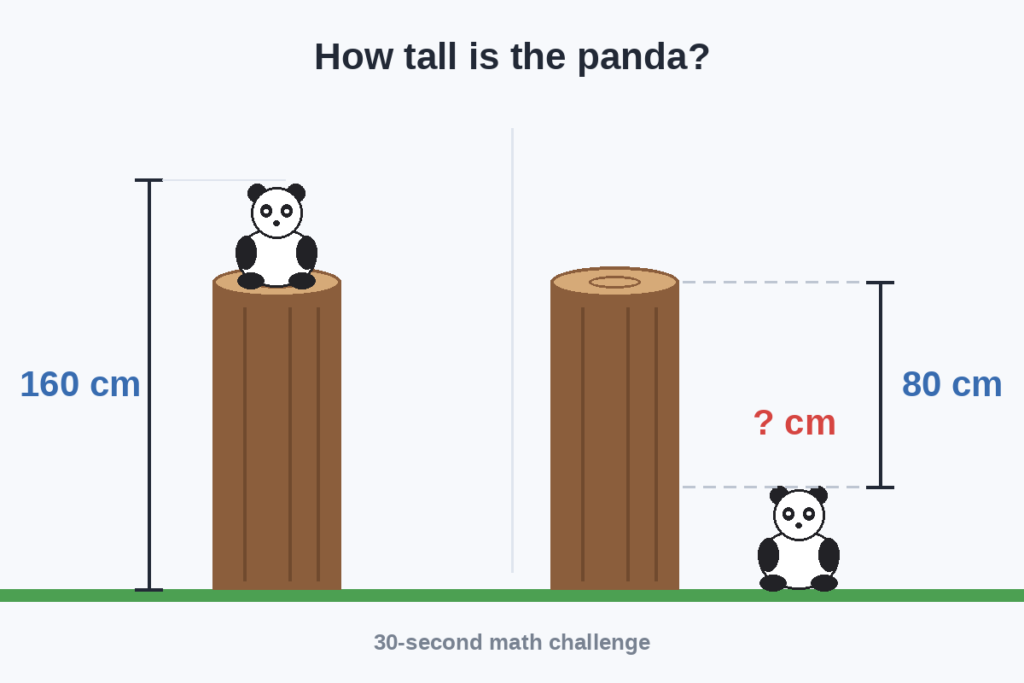
Deep in a bamboo forest, a young field researcher was watching a panda wander between two old tree stumps. At one point the animal climbed onto a stump and sat on top of it. A little later it sat on the ground right next to an identical stump. The researcher wanted to record the panda’s height, but the tape measure was back at the field station. Instead of giving up, the researcher took two quick readings and let algebra do the rest.
This is one of the quiet strengths of mathematics: it lets you uncover a value you cannot measure directly. Surveyors work out the height of buildings they never climb, astronomers estimate distances to stars nobody will ever visit, and engineers size bridges long before a single beam is in place. All of them rely on the same idea, turning a few well-chosen observations into equations.
The challenge
The researcher’s notebook contains two observations. Your mission is to find the height of the panda, without trying to guess it from the drawing.
Given information:
- Scene 1: the panda sits on top of a tree stump, and the total height from the ground to the top of the panda’s head is 160 cm
- Scene 2: the panda sits on the ground next to an identical stump, and the top of the stump is 80 cm higher than the top of the panda’s head
- Both stumps have exactly the same height
- Question: how tall is the panda?
Pay attention to what each number measures before you start calculating. Ready? Your 30 seconds start now.
What this challenge trains
This puzzle teaches you to translate a picture into equations, and above all to tell a total height apart from a difference in height. Mixing up those two ideas is the fastest way to a wrong answer. It also works on addition, subtraction and first-degree equations, and it shows how two pieces of information that look incomplete on their own can pin down an unknown value once they are combined.
Step 1: read the two scenes carefully
In the first scene, the 160 cm covers two things stacked on top of each other: the stump and the panda. It is a sum.
In the second scene, the 80 cm is not the height of anything. It is the gap between the top of the stump and the top of the panda’s head, so it is a difference. That is the detail the whole puzzle hinges on.
Step 2: name the unknowns
Let T be the height of a stump and P the height of the panda. We are looking for P.
Scene 1 gives a sum, and scene 2 gives a difference:
T − P = 80
Two equations, two unknowns. That is all we need.
Step 3: add the two equations
The first equation contains +P and the second contains −P. If we add the equations side by side, those two terms cancel each other out:
2T = 240
The panda has vanished from the equation, which leaves a single unknown.
Step 4: find the height of the stump
Divide both sides by 2:
T = 120 cm
Each stump is 120 cm tall. This is not the answer yet, but it unlocks it.
Step 5: find the height of the panda
Go back to the first equation and replace T with 120:
P = 160 − 120
P = 40 cm
The panda is 40 cm tall.
Check the answer
A good solver always checks the result against both scenes.
Scene 1, panda on the stump:
Scene 2, panda on the ground next to the stump:
Both observations are satisfied, so the answer holds.
A faster shortcut
Once you see the structure, there is an even quicker route. The total of 160 cm contains the stump plus the panda, while the 80 cm is the stump minus the panda. Subtracting one from the other removes the stump entirely and leaves twice the panda’s height:
80 ÷ 2 = 40 cm
Same result, in two lines. The trap would be to read 80 cm as the panda’s height, or to subtract it from 160 and stop at 80 without halving.
Looking is not the same as observing
At first glance this picture shows nothing more than a panda and two stumps. Yet behind it sits a small system of equations, and the hidden height appears as soon as each number is given its true meaning. A total and a difference may look alike on a diagram, but they tell completely different stories. Taking a few seconds to understand what is being measured is often the step that makes the rest of the calculation easy, in math class and well beyond it.
So, did you find 40 cm before the time ran out? If you got another number, go back to the second scene and look at where the 80 cm starts and ends. Share the puzzle with friends and family to see who spots the trap first, and come back for the next daily challenge.