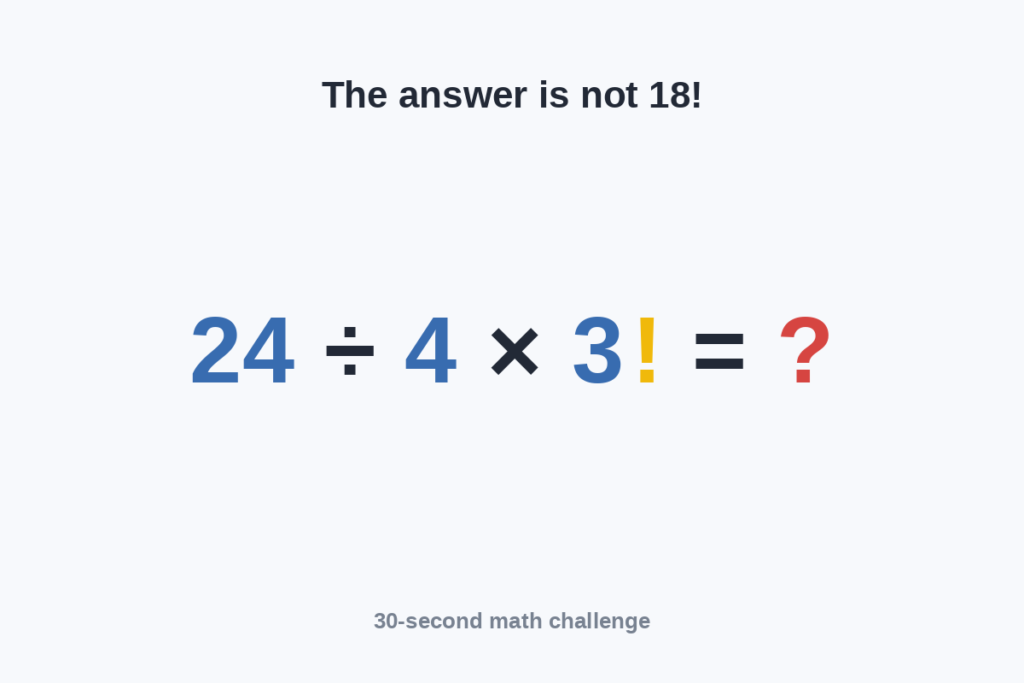
A teacher writes a short calculation on the board and adds one line underneath: “The answer is not 18.” Half the class frowns, the other half is already sure they have it. Only a tiny symbol stands between them and the right result. You have 30 seconds to find it.
Picture a classroom on a Monday morning. The teacher, Mrs. Harlow, promises the group that today’s exercise is “the easiest of the year”. She chalks four numbers, two operators and one little exclamation mark on the board. Hands shoot up almost instantly. Most of the students answer the same number, and most of them are wrong.
When she writes the solution, a few faces fall. Nobody had made a mistake with the division or the multiplication. They had simply treated the exclamation mark as decoration, as if the calculation were shouting at them. In mathematics, that little stroke and dot is not punctuation at all. It is an operation, and it changes everything.
That is today’s challenge. It mixes a division, a multiplication and a factorial, and the statement itself warns you that the answer is not 18. Read every symbol carefully before you start.
Given information
- The calculation to solve is 24 ÷ 4 × 3!
- The “!” is attached directly to the number 3
- There are no parentheses anywhere in the expression
- The statement claims that the answer is not 18
- Time limit: 30 seconds, no calculator
What this challenge trains
This puzzle works on two skills at once. The first is operator precedence, in particular the rule that multiplication and division share the same priority and are worked out from left to right. The second is the factorial notation, a symbol that shows up constantly in combinatorics and probability but that many people have not used since school. It also trains a habit that matters far beyond math: checking what a symbol really means before trusting your first instinct, and checking a claim before accepting it.
Time to play
Look at the calculation one more time: 24 ÷ 4 × 3! Ready? 30 seconds, starting now.
30… 20… 10… 5… 4… 3… 2… 1… Time is up!
Step 1: decode the exclamation mark
When “!” follows a whole number, it means factorial. The factorial of a positive whole number is the product of every positive whole number from that number down to 1. For example, 4! is:
In our challenge, the factorial applies to 3:
3 × 2 = 6
6 × 1 = 6
3! = 6
So the “3” on the board is really worth 6 once the factorial is applied.
Step 2: replace the factorial in the calculation
Factorials are evaluated before multiplication and division, so we swap 3! for its value right away:
24 ÷ 4 × 6
Only a division and a multiplication remain. It looks finished, but there is still one rule to respect.
Step 3: work from left to right
Multiplication does not take priority over division. The two operations sit at the same level, so when no parentheses are present, you simply process them in reading order, from left to right. The division comes first here:
6 × 6 = 36
The right answer is 36.
Checking the result
Let us run through the full calculation in a single pass to make sure no step was skipped:
= 24 ÷ 4 × 6
= 6 × 6
= 36
Factorial first, then division, then multiplication: we land on 36 again.
Where 18 comes from
Anyone who reads the “!” as an excited punctuation mark will calculate 24 ÷ 4 × 3, which gives 6 × 3 = 18. That is exactly the answer the statement rules out. In standard mathematical notation, an exclamation mark stuck to a number always means factorial, so 18 is not the expected result.
The other classic trap: getting 1
A second group of solvers decodes the factorial correctly, then multiplies before dividing:
24 ÷ 24 = 1
This would only be correct if the calculation were written with parentheses, as 24 ÷ (4 × 3!). Without them, the division must be done first, and the result stays 36. Multiplication and division are equals: position decides, not the operator.
The method to remember
For this kind of expression, follow the same order every time:
- Parentheses first, if there are any
- Then powers and factorials
- Then multiplications and divisions, from left to right
- Finally additions and subtractions, from left to right
A tiny symbol, a big difference
This challenge is a good reminder that a confident statement is not a proof. “The answer is not 18” only becomes convincing once you have checked the meaning of each symbol and applied the rules in the right order. The same discipline is what keeps navigation software, medical devices and financial models from producing wildly wrong numbers.
So, did you find 36 before the countdown ended? If you got 18 or 1, you now know exactly which step tripped you up. Try the puzzle on a friend and see who spots the factorial first.