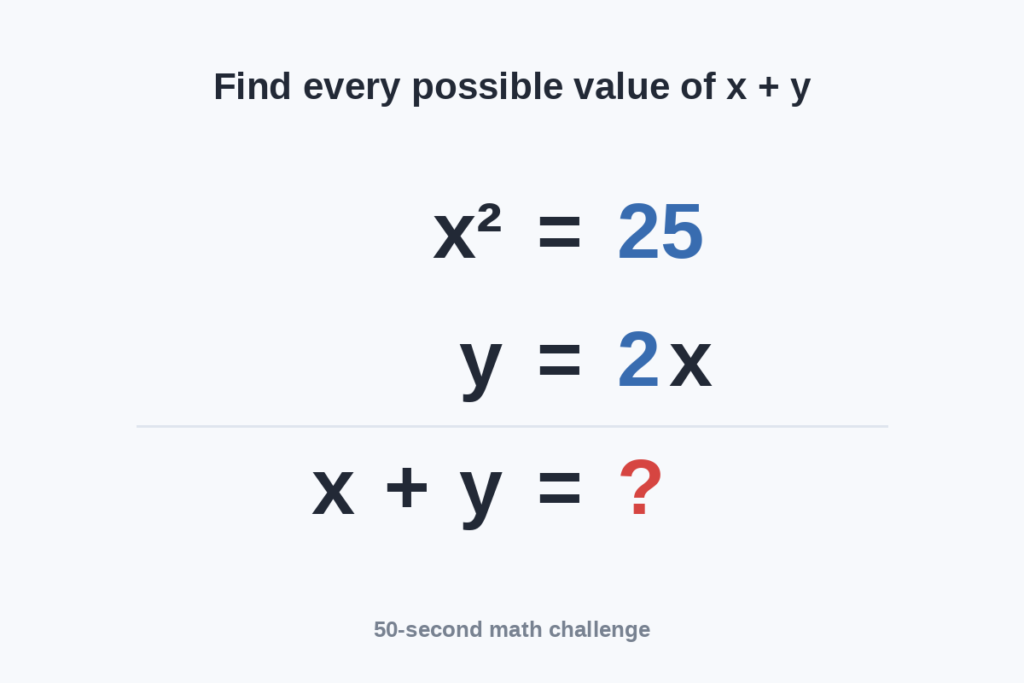
Two short lines, one question: if x² = 25 and y = 2x, what is x + y? Most people blurt out 15 within a few seconds and move on. They are only half right. You have 50 seconds to find every possible answer.
Picture a high school student who dreams of building robots. In class, equations with letters feel like pointless puzzles to her. Then a teacher explains something that changes everything: a robot arm never “sees” where it is going. It works out its next position from relationships between numbers, exactly like the ones on the blackboard. One value depends on another, and a missing piece is deduced from the pieces you already have.
From that day on, every equation becomes a small mystery with a hidden answer. And she learns a habit that every engineer relies on: when you think you have found the solution, check whether there is another one hiding in plain sight. A robot that only considers one possible position is a robot that will eventually crash into something.
Today’s challenge is built around that very habit. Two equations, two unknowns, and one detail that catches a lot of quick thinkers off guard.
Given information
- First equation: x² = 25
- Second equation: y = 2x
- Question: what is the value of x + y?
- Time limit: 50 seconds, no calculator
- Hint: how many different numbers have a square equal to 25?
What this challenge trains
This puzzle works on your handling of equations and unknowns: you need to find one value, then use it to unlock the second. It also tests your understanding of squares and square roots, and more precisely the fact that an equation with a square in it can have more than one solution. It builds logical deduction, since the first equation feeds the second. Above all, it sharpens your critical thinking: a complete answer in mathematics has to cover every case the statement allows, not just the first one that comes to mind.
Time to play
Look at the two equations once more. Find x, then y, then add them up. And do not stop at the first result. Ready? 50 seconds, starting now.
50… 40… 30… 25… 20… 15… 10… 5… 4… 3… 2… 1… Time is up!
Step 1: read the two equations carefully
The first equation tells us that x multiplied by itself gives 25. The second tells us that y is always twice x. So the plan is simple: list every value x can take, compute the matching y for each one, then add the two numbers together.
y = 2x
x + y = ?
Step 2: solve x² = 25, all of it
Which number, multiplied by itself, gives 25? The answer that jumps out is 5:
But a negative number multiplied by a negative number gives a positive result. So −5 works just as well:
The equation x² = 25 has two real solutions: x = 5 or x = −5. This is the trap of the whole challenge, and everything that follows depends on it.
Step 3: first case, x = 5
We plug x = 5 into the second equation to get y:
y = 10
Now we add the two values:
x + y = 15
That is a perfectly valid answer. It is just not the only one.
Step 4: second case, x = −5
Same method, starting from the negative solution. A positive number times a negative number gives a negative result:
y = −10
And the sum becomes:
x + y = −15
This second pair also satisfies both equations. Nothing in the statement allows us to throw it away.
A faster shortcut
There is an even quicker way to get there. Since y = 2x, you can replace y directly in the sum, before computing anything:
x + y = 3x
The sum is simply three times x. With the two possible values of x, the two answers fall out immediately:
x = −5 → 3 × (−5) = −15
Same results, fewer steps. Simplifying an expression before plugging in numbers often saves precious seconds.
Checking both solutions
A good mathematician always checks that each answer respects every condition of the problem.
5² = 25 ✓
2 × 5 = 10 ✓
5 + 10 = 15
(−5)² = 25 ✓
2 × (−5) = −10 ✓
−5 + (−10) = −15
Both pairs pass the test. The problem genuinely has two solutions.
Why √25 and x² = 25 are not the same thing
This is where the confusion usually comes from. The square root symbol √25 refers to one specific number, the positive one, so √25 = 5. Solving the equation x² = 25 is a different question: it asks for every number whose square is 25, and there are two of them.
x² = 25 means x = 5 or x = −5
Keeping that distinction in mind avoids a whole family of mistakes in second-degree equations, from school exercises to physics problems.
The final answer: 15 or −15
x + y = 15 or x + y = −15. If the statement had said that x is positive, 15 would be the only answer. Since it says nothing of the kind, both results are mathematically correct, and answering only 15 leaves the job half done.
Thinking like a mathematician
This challenge looks almost too easy at first glance, and that is exactly why it works. The answer 15 arrives so fast that it feels finished. Yet a careful look reveals a second solution that is just as valid.
That is the real lesson here: do not stop at the first result, question your assumptions, and check whether other possibilities exist. Engineers, programmers and scientists use this reflex every day, and it starts with exercises as small as this one.
So, did you find 15, −15, or both before the countdown ended? If you spotted both, congratulations, you saw the subtlety. If you only found 15, you were right, just not completely. Try the challenge on your friends and family and see who catches the negative solution first.