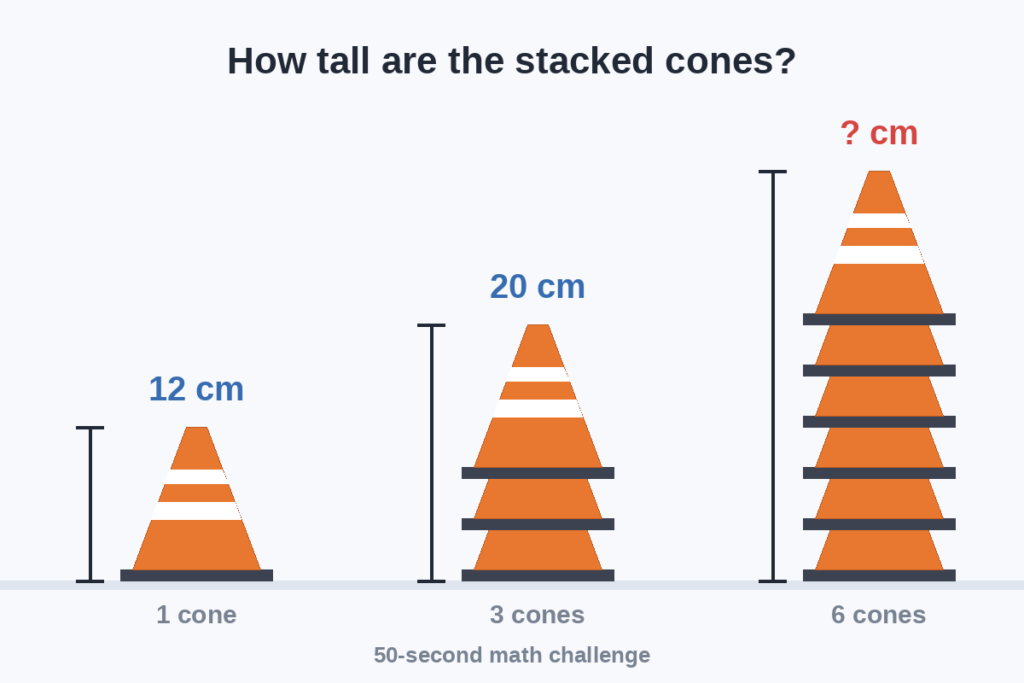
One orange cone stands 12 cm tall. Slide two more over it and the stack only reaches 20 cm. So how tall is a stack of six identical cones? It looks like a simple multiplication, but it is not. You have 50 seconds to find the answer.
Meet Clara, a junior engineer at a company that designs storage for a busy hospital supply room. Her team has been asked to cut the amount of shelf space taken up by plastic containers. The idea is simple: pick containers that nest inside each other, so a tall pile takes up a fraction of the room a loose pile would need.
Before anyone orders a single box, Clara has to answer one question: how high does a stack grow every time another piece is added? If she gets it wrong, the shelves will be too low, or the order will be far too big for the space. A small geometry puzzle suddenly decides whether a whole project works.
Today’s challenge is built on exactly the same idea. Three stacks of identical cones are lined up next to each other. Two of their heights are known, the third is up to you.
Given information
- All the cones are identical and nest partly inside one another
- 1 cone on its own measures 12 cm
- A stack of 3 cones measures 20 cm
- Question: how tall is a stack of 6 cones?
- Time limit: 50 seconds, no calculator
What this challenge trains
This puzzle sharpens your observation and logical reasoning: you have to notice that the cones overlap, so the heights cannot simply be added up. It also works on simple equations and constant growth, since the key is to isolate how much height each extra cone brings. Finally, it is a practical piece of everyday geometry: the same reasoning applies to paper cups, mixing bowls, flower pots, or any object that stacks by nesting. And it trains patience, because the first answer that comes to mind here is a trap.
Time to play
Look at the three stacks again: 12 cm for one cone, 20 cm for three, and a question mark for six. Ready? 50 seconds, starting now.
50… 40… 30… 20… 10… 5… 4… 3… 2… 1… Time is up!
Step 1: understand how the stack grows
When you place a cone over another one, most of it slides down around the cone below. Only a small part sticks out above. This means each new cone adds less than 12 cm to the total height. The first cone counts for its full 12 cm, then every extra cone adds the same fixed amount. Our first job is to find that amount.
Step 2: compare the first two stacks
Going from 1 cone to 3 cones, the height goes from 12 cm to 20 cm. The difference comes from the two cones that were added:
Since the cones are identical and nest in exactly the same way, each of the two extra cones adds the same height:
Every extra cone raises the stack by 4 cm. That is the whole secret of this challenge.
Step 3: write it as an equation
Let us call h the height added by each extra cone. A stack of 3 cones is the first cone plus two extra ones:
2h = 20 − 12
2h = 8
h = 8 ÷ 2
h = 4 cm
The equation confirms what we found by comparing the stacks.
Step 4: calculate the height of 6 cones
In a stack of 6 cones, there is the first cone plus 5 extra cones. Calling H the total height:
5 × 4 = 20
H = 12 + 20
H = 32 cm
The right answer is 32 cm.
Checking the result
Let us build the stack one cone at a time, adding 4 cm each step:
2 cones: 12 + 4 = 16 cm
3 cones: 12 + 2 × 4 = 20 cm
4 cones: 12 + 3 × 4 = 24 cm
5 cones: 12 + 4 × 4 = 28 cm
6 cones: 12 + 5 × 4 = 32 cm
The 3-cone stack lands exactly on the 20 cm we were given, which shows the rule fits the data. The 6-cone stack reaches 32 cm.
A formula for any stack
Once the rule is known, you never need to measure again. For a stack of n cones:
The term n − 1 counts the cones added after the first one. For 10 cones, for example:
H = 12 + 9 × 4
H = 12 + 36
H = 48 cm
This is what mathematicians call an arithmetic sequence: a starting value, then the same amount added again and again.
The two traps in this puzzle
The most common mistake is to multiply the height of one cone by the number of cones:
That would only be true if the cones were stacked flat on top of each other with no nesting at all. The picture clearly shows they slide into one another.
The second trap is more tempting: since 3 cones measure 20 cm, 6 cones should measure twice as much, so 40 cm. The problem is that this doubling counts the full 12 cm base cone twice. The first cone counts once, only the extra cones add 4 cm each.
Look past the obvious
A handful of orange cones was enough to uncover a rule that warehouses, packaging designers and logistics teams use every day to save space, transport costs and energy. Spotting the constant step, separating it from the starting value, then applying it: that is the whole method, and it works far beyond cones.
So, did you find 32 cm before the countdown ended? If you answered 72 or 40, you now know exactly where the reasoning slipped. Share the puzzle with a friend and see who spots the 4 cm rule first.