Three small numbers, a pair of parentheses and four basic operations: today’s equation looks like something you could solve with your eyes closed. Yet it hides one of the most common traps in arithmetic, and you only have 30 seconds to avoid it.
Picture a world where nobody agreed on the order in which calculations should be done. Two people could start from exactly the same numbers and end up with two different answers, simply because one worked from left to right and the other did not. Bank statements, engineering plans and medical doses would all become a matter of opinion. To prevent that chaos, mathematics relies on a small set of shared rules that tell everyone which step comes first.
Those rules are humble, but they sit underneath an enormous amount of human progress. Long before computers, mathematics helped raise monuments, chart the paths of the planets and build instruments precise enough to measure time. Today it drives software, medicine, engineering and space missions. And behind each of those achievements, you will find the same elementary operations most of us learned in our first years at school.
You probably remember those quick classroom exercises that seemed too easy to bother with. A couple of additions, a multiplication, a division, and off you went, calculating from left to right without a second thought. Then came the correction, and the realization that a single slip in the order of operations had changed everything. That is how many of us learned that in mathematics, speed never replaces rigor.
The challenge
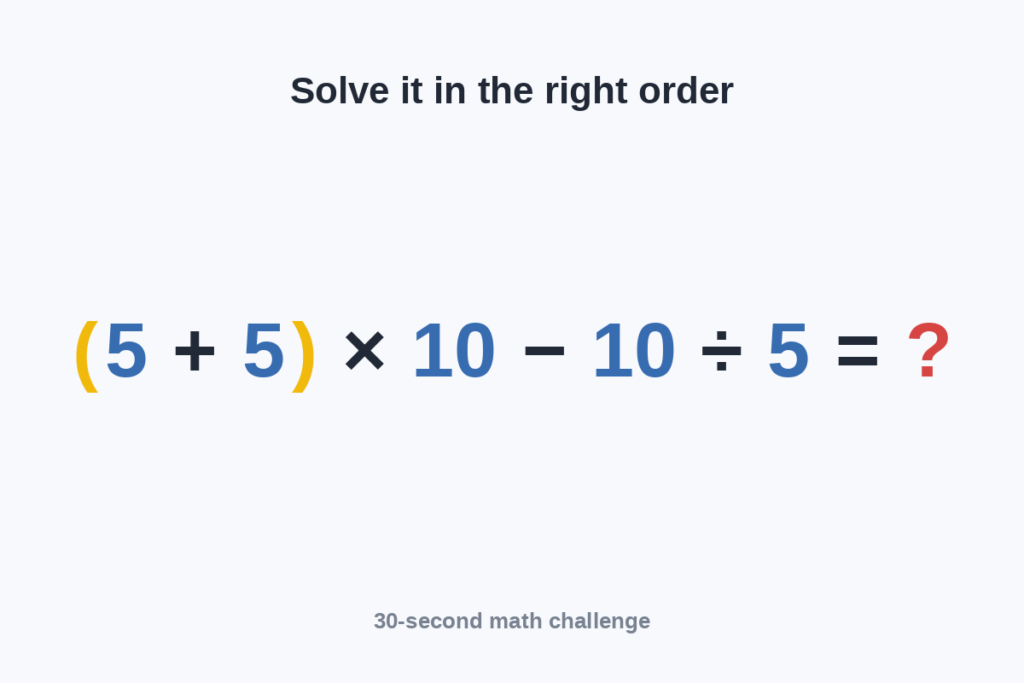
Here is the equation on today’s board:
Given information:
- One addition inside parentheses: 5 + 5
- One multiplication by 10
- One subtraction of 10
- One division by 5
- No calculator, and only 30 seconds on the clock
One warning before you start: do not simply work through the operations in the order you read them. To land on the right result, you will need to remember the priority rules that govern this kind of calculation. Take a breath, decide what comes first, and go!
Quote of the day
“Mathematics is the queen of the sciences.” Carl Friedrich Gauss
Gauss was pointing at the central place mathematics holds in all scientific knowledge. It describes phenomena, builds models and checks reasoning with precision. But part of its strength lies somewhere more modest: it trains us to think with method, even when the problem in front of us looks trivial.
What this challenge trains
This puzzle strengthens your command of the order of operations, in particular how parentheses, multiplication and division take precedence. It teaches you to identify which step must be done first and to check each intermediate result before moving on. Along the way, it sharpens focus, mental arithmetic and speed of reasoning, and it helps you resist the errors that come from rushing. Those habits pay off far beyond school, from managing a budget to solving everyday problems at work.
How did you do?
- Found it fast and right: you have excellent logic and strong analytical skills.
- Found it after some thought: you know how to structure your reasoning and check each step.
- Not found or wrong answer: no worries, this is exactly the kind of exercise that builds method and precision.
Step-by-step solution
At first sight, nothing here looks difficult: every number is small. The catch is entirely in the order. Ignore the priority rules and you will almost certainly get a wrong answer.
Step 1: start with the parentheses
The first rule is simple: whatever sits inside parentheses is calculated before anything else. Here, the parentheses hold an addition:
Replace the parentheses with that result, and the equation becomes:
The parentheses are gone, but several operations remain, and the priority rules still apply.
Step 2: handle the multiplication and the division
After parentheses, multiplication and division come before addition and subtraction. Both share the same level of priority, and in this equation they do not touch each other, so each can be worked out on its own:
10 ÷ 5 = 2
Swap each operation for its result:
Step 3: finish with the subtraction
Only one operation is left. With parentheses, multiplication and division out of the way, the subtraction can finally be done:
The result is 98.
Step 4: understand the trap
The trap is the temptation to treat the line like a sentence and calculate everything from left to right. Someone who subtracts before dividing will reach a completely different number. The rules are clear, though: the division must happen before the subtraction.
Here is the order to keep in mind:
- Calculations inside parentheses
- Multiplications and divisions, from left to right
- Additions and subtractions, from left to right
Followed in that order, the equation leads naturally to 98. What makes this puzzle interesting is not the size of the numbers, but the need for a reliable method.
Checking the answer
Before locking in the answer, let’s replay the whole calculation from the original line to make sure no step slipped:
= 10 × 10 − 10 ÷ 5
= 100 − 2
= 98
Every step holds. Final answer: 98. Parentheses first, then the multiplication and the division, and the subtraction last.
In mathematics, order changes everything
This little equation carries a big lesson: knowing how to add, multiply and divide is not enough, you also need to know when to do each one. A single operation performed at the wrong moment can turn a correct method into a wrong answer. The same discipline matters well outside the classroom, in computer programming, scientific calculations and financial tools, where respecting these rules is what makes results trustworthy.
So, did you find 98 before the 30 seconds were up? Did the order of operations jump out at you straight away, or did you hesitate between several answers? Share your result and your method in the comments, and challenge your friends to beat your time!