Deep in an African wildlife reserve, a young field researcher spends his mornings watching three big cats: a proud lion, a powerful tiger and a spotted leopard. One evening, his mentor hands him an unusual notebook. Inside, each animal stands for a secret number, and four short lines of math hide the answer to a final riddle.
His first instinct is to guess. A lion feels like a big number, a leopard maybe a small one. Every guess falls apart within seconds. Then he slows down, reads the lines one by one and realizes that the notebook already contains every clue he needs, as long as he follows them in the right order.
That is the quiet power of mathematics. Biologists use it to estimate animal populations, meteorologists to forecast storms, engineers to design bridges that stay standing. Behind all of it sit simple operations applied with care. A teacher once gave a class a riddle made only of animal drawings: the students who rushed to guess got lost, while the one who patiently worked line by line found the answer. Today, it is your turn to be that patient student, and watch out, because the last line hides a trap that catches a lot of people.
The challenge
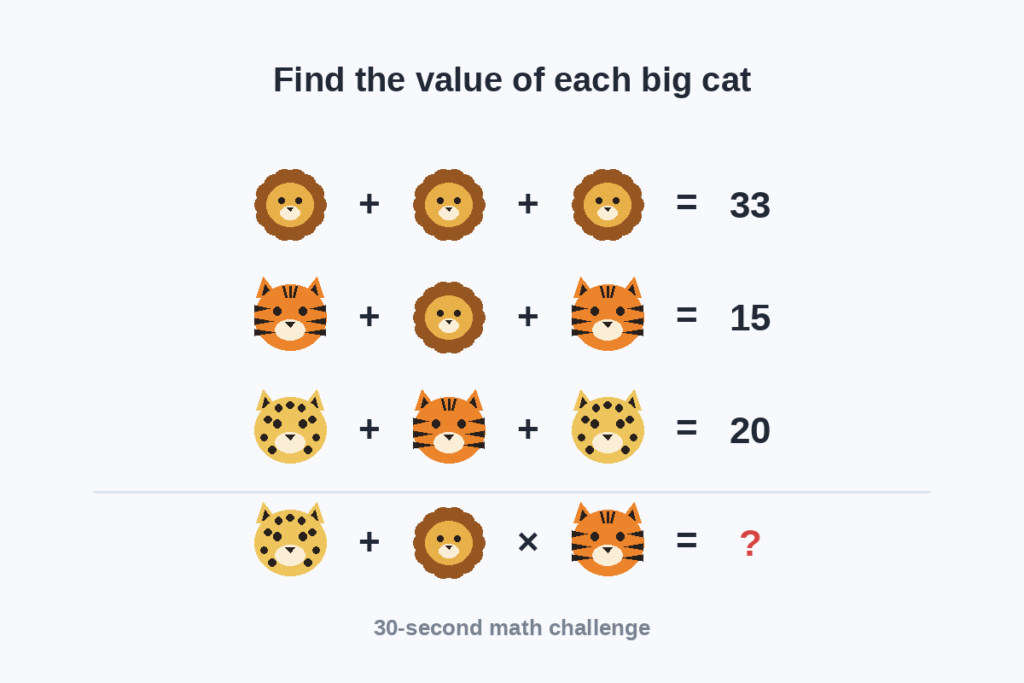
Each big cat represents one number, and that number never changes from one line to the next. Here is what the notebook says:
- Line 1: lion + lion + lion = 33
- Line 2: tiger + lion + tiger = 15
- Line 3: leopard + tiger + leopard = 20
- Line 4: leopard + lion × tiger = ?
Find the value of each animal, then solve the last line. You have 30 seconds, no calculator allowed. Trust your logic, but do not rush!
30… 25… 20… 15… 10… 5, 4, 3, 2, 1… Time is up!
A word from David Hilbert
The German mathematician David Hilbert once said: “Mathematics knows no races or geographic boundaries; for mathematics, the cultural world is one country.” Whatever your language or background, the rules of arithmetic are the same everywhere, and that shared logic is exactly what this puzzle puts to the test.
What this challenge trains
This puzzle builds your ability to spot relationships between several unknowns and to solve them one after another, using each answer to unlock the next line. It exercises addition, subtraction, multiplication and division, and above all it checks whether you respect the order of operations when a line mixes different signs.
How did you do?
- Right answer, fast: excellent logic and a sharp eye for detail.
- Right answer after some thought: you know how to structure your reasoning and check each step.
- Wrong answer or no answer: no problem, this type of puzzle is a great way to build method and precision.
Step 1: find the lion
The first line is the natural starting point because it contains only one animal. Three identical lions add up to 33. Call the lion L:
3L = 33
L = 33 ÷ 3
L = 11
Each lion is worth 11, and that value holds in every other line.
Step 2: find the tiger
The second line has two tigers and one lion. Since we now know the lion, we can replace it with 11 and call the tiger T:
2T + 11 = 15
2T = 15 − 11
2T = 4
T = 4 ÷ 2
T = 2
Each tiger is worth 2. Two of the three values are now known.
Step 3: find the leopard
The third line contains two leopards and one tiger. Replace the tiger with 2 and call the leopard P:
2P + 2 = 20
2P = 20 − 2
2P = 18
P = 18 ÷ 2
P = 9
Each leopard is worth 9.
Step 4: check the three values
Before tackling the last line, it is worth plugging the values back into the first three. A mistake here would ruin everything that follows.
2 + 11 + 2 = 15 ✔
9 + 2 + 9 = 20 ✔
Lion = 11, tiger = 2, leopard = 9. All three lines check out.
Step 5: solve the last line
Now replace each animal in the final line with its value:
= 9 + 11 × 2
Here is the key rule: multiplication comes before addition when there are no parentheses. So we first compute 11 × 2, then add the leopard:
9 + 22 = 31
The answer is 31.
Step 6: understand the trap
The first three lines contain only additions, so your brain gets used to reading from left to right. The last line quietly switches to a mix of addition and multiplication. Many people keep the same reflex and add first:
20 × 2 = 40
That gives 40, which is wrong. This calculation actually answers a different question, one where the addition sits inside parentheses:
9 + 11 × 2 = 31
Knowing the value of every animal is only half the job; you also need to know in which order to combine them. If you found 40, you fell into exactly the trap this puzzle was built around.
The final answer: 31
The lion is worth 11, the tiger 2 and the leopard 9. By multiplying before adding, we get 9 + 22 = 31.
Puzzles like this one show how a few cartoon animals can hide a real piece of reasoning: break the problem into small steps, reuse each result to unlock the next, then stay alert when the rules of the game change on the last line. Did you find 31 before the 30 seconds ran out, or did the big cats lure you toward 40? Share the puzzle with friends and family and see who keeps the sharpest eye.