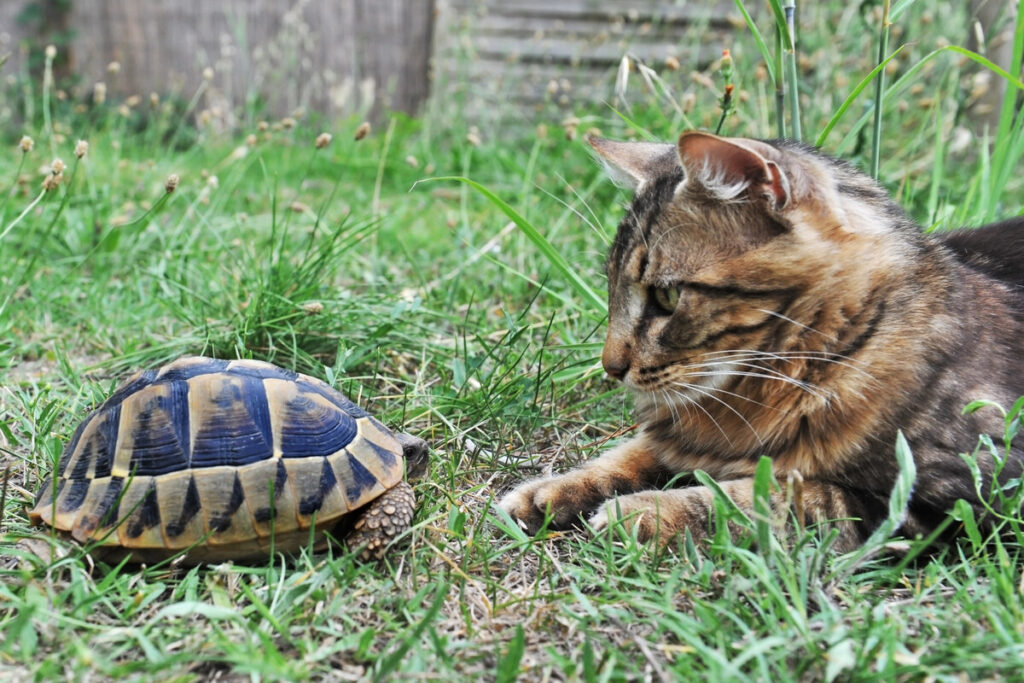
A math teacher once settled an argument in the strangest way possible: instead of pulling out a tape measure, he asked a cat and a tortoise to help him find the height of his table.
He placed the cat on top of the table first, with the tortoise resting on the floor beside it. Then he swapped their positions: the tortoise climbed onto the table while the cat stayed on the ground. By comparing the two setups, he claimed he could work out the exact height of the table without ever touching a ruler. His secret had nothing to do with magic, just two simple equations.
This is one of the oldest tricks in mathematics: finding an unknown value by comparing two situations that share the same hidden variables. Engineers, architects and scientists still rely on the same logic today whenever a measurement cannot be taken directly.
Given information
- When the cat sits on the table and the tortoise stays on the floor, the top of the cat is 170 cm higher than the top of the tortoise.
- When the two animals swap places, the top of the tortoise is 130 cm higher than the top of the cat.
You have 50 seconds. Can you figure out the exact height of the table using only these two measurements?
Quote of the day
“The essence of mathematics lies in its freedom.” Georg Cantor
Cantor’s words are a reminder that a single problem can be solved in more than one way: through equations, through comparison, or sometimes just by spotting a pattern.
What this challenge trains
This puzzle sharpens logical reasoning and the ability to translate a real situation into equations. It trains you to isolate an unknown value, compare two measurements, and eliminate variables instead of guessing. It also teaches the difference between a total height and a height difference, two ideas that are easy to confuse under time pressure.
Solving the puzzle step by step
At first glance the problem looks impossible: we know neither the cat’s height nor the tortoise’s. But the two situations together give us exactly enough information to find the table’s height without ever calculating the animals’ own sizes.
Setting up the unknowns
Let T be the height of the table, C the height of the cat, and R the height of the tortoise. The goal is to find T only, by eliminating C and R from the equations.
Writing the first equation
When the cat sits on the table and the tortoise stays on the floor, the top of the cat equals the table’s height plus the cat’s height, and that point sits 170 cm above the tortoise:
T + C − R = 170
Writing the second equation
When the animals swap, the top of the tortoise equals the table’s height plus the tortoise’s height, which this time sits 130 cm above the cat:
T + R − C = 130
Adding both equations
Here is the trick: C and −C cancel out, and so do R and −R, as soon as the two equations are added together.
2T = 170 + 130 = 300
Isolating the table’s height
Dividing both sides by 2 gives the answer directly:
T = 150 cm
The table measures exactly 150 centimeters, or 1.5 meters.
Checking the result
Replacing T with 150 in the first equation gives C − R = 20, meaning the cat is 20 cm taller than the tortoise. The second equation then gives R − C = −20, which is perfectly consistent. The answer holds up.
Why it matters
This small exercise shows how two seemingly complicated measurements can combine into one simple result. The same method, adding two equations so that opposite unknowns cancel out, is used far beyond puzzles: in construction, physics and engineering, whenever a measurement cannot be taken directly.