Picture a surveyor who never leaves her desk. A neighbor asks how far her front door is from the spot where he is standing, and instead of grabbing a tape measure, she sketches a few lines on a notepad and calls out the answer in under a minute. Today, you get to do the same thing.
Geometry has always been the art of measuring what you cannot reach. Long before satellites and laser rangefinders, builders, sailors and mapmakers worked out distances by breaking a messy route into simple straight pieces. Bridges, flight paths and street maps still rely on that exact habit of mind today.
The trap in puzzles like this one is very human: you see several labelled segments and your first instinct is to add them all up. But the route you walk is not the distance as the crow flies. The real trick is to sort the movements into “across” and “up or down” before doing any arithmetic.
The challenge
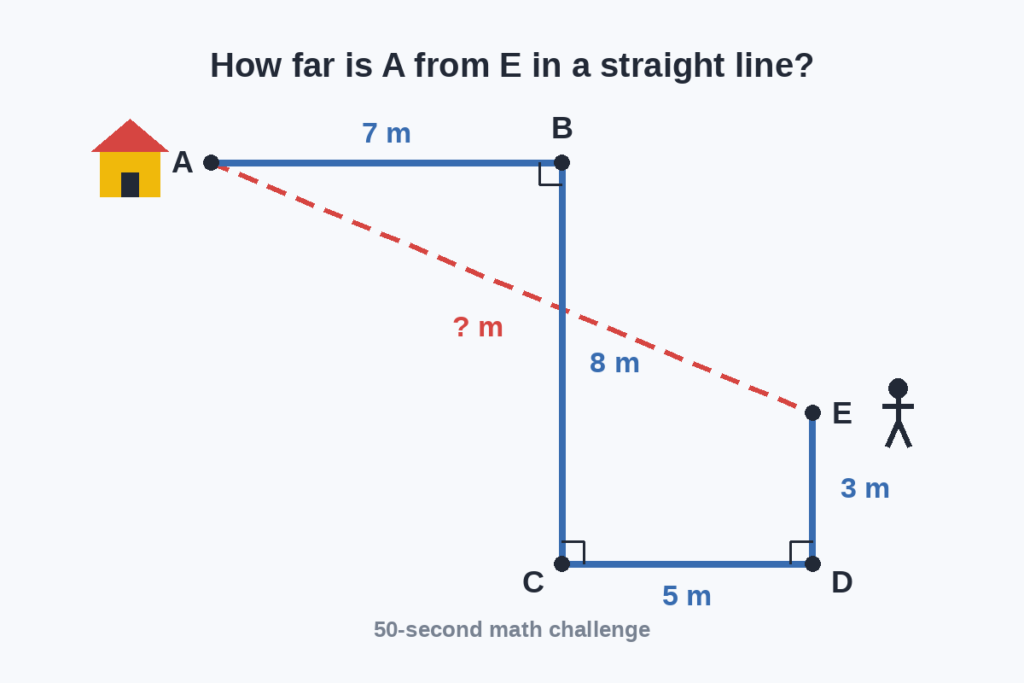
A house stands at point A. A person is waiting at point E. Between them, a winding path runs through points B, C and D, and every corner along the way is a right angle. Your mission is to find the straight-line distance from A to E, shown as the red dashed line in the diagram. Not the length of the path, just the direct distance.
Given information
- AB is horizontal and measures 7 m
- BC goes straight down from B and measures 8 m
- CD is horizontal, continuing in the same direction as AB, and measures 5 m
- DE goes straight back up from D and measures 3 m
- All marked angles are right angles
- Question: what is the distance AE in a straight line?
Set a timer for 50 seconds and give it a try before reading on.
A thought to keep in mind
“There is no royal road to geometry.” This line, traditionally attributed to Euclid, is a reminder that there is no magic shortcut that skips the reasoning. Yet once you spot the right property, a figure that looks intimidating turns out to be surprisingly friendly.
What this challenge trains
This little puzzle works several skills at once: reading a figure carefully, telling horizontal moves apart from vertical ones, recognizing a hidden right triangle and applying the Pythagorean theorem. It also builds the reflex of decomposing a complicated shape into simple parts, the same reflex architects, engineers and navigators use every day.
Step-by-step solution
Step 1: add up the horizontal moves
Only two segments move sideways: AB and CD. Both point in the same direction, so the total horizontal gap between A and E is simply their sum.
Horizontal distance = 7 + 5 = 12 m
Step 2: work out the vertical gap
The path drops 8 m from B to C, then climbs back up 3 m from D to E. Because the two vertical moves go in opposite directions, we subtract rather than add.
Vertical distance = 8 − 3 = 5 m
So point E sits 12 m across from A and 5 m lower than A. Those two numbers are the legs of a right triangle whose longest side, the hypotenuse, is exactly the distance AE we are looking for.
Step 3: apply the Pythagorean theorem
In a right triangle, the square of the hypotenuse equals the sum of the squares of the two other sides.
AE² = 144 + 25
AE² = 169
AE = √169 = 13 m
The straight-line distance between point A and point E is 13 meters.
Why the answer is not 23 meters
If you added every segment (7 + 8 + 5 + 3), you got 23 m. That is the length of the walk along the path, not the gap between the house and the person. The winning move was to ignore the zigzag, keep only the net horizontal and net vertical displacement, and let Pythagoras do the rest. As a bonus, you just met one of the most famous whole-number right triangles: 5, 12 and 13, a classic Pythagorean triple that shows up again and again in puzzles and exams.
How did you do?
If you found 13 m before the timer ran out, your spatial reasoning is in great shape. If it took a little longer, you clearly know how to structure a solution and check each step. And if you fell for the 23 m trap, no worries: this kind of exercise is exactly how the right reflexes are built. Try it on a friend and see who spots the hidden triangle first.