Long before anyone owned a calculator, people were already hunting for patterns in numbers. Today’s puzzle puts you in their shoes: four short lines, one hidden rule, and only 30 seconds on the clock.
Some four thousand years ago, scribes in Mesopotamia used numbers to measure fields, keep track of trade and follow the movement of the stars across the night sky. Along the way, they noticed something remarkable: numbers obey rules, and once you spot a rule, you can use it to answer questions you have never seen before. Without knowing it, they were laying the groundwork for one of the most powerful tools humanity has ever built.
Mathematics went on to raise monuments, guide ships across oceans and explain natural phenomena. Today it runs quietly behind telecommunications, medicine, architecture, artificial intelligence and space exploration. Yet its real value is not the arithmetic itself. It is the habit of looking closely, comparing carefully and reasoning step by step. Sometimes, a handful of numbers placed in the right order is enough to reveal a surprising rule.
The challenge
At first glance, this puzzle looks almost too simple. But the lines on the board do not follow the usual arithmetic you use every day: a 3 does not normally turn into a 10. Your job is to work out what transformation hides behind these results.
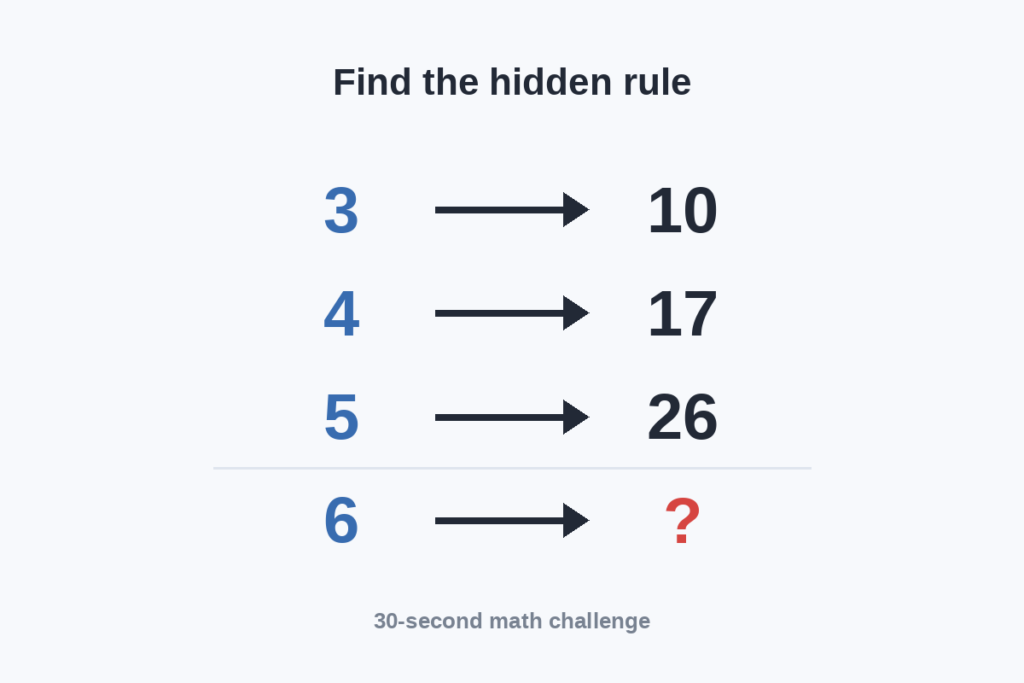
Here is what the board shows:
- 3 gives 10
- 4 gives 17
- 5 gives 26
- 6 gives ?
Find the number that replaces the question mark. A small hint: the secret is not simply to add the left number to the right one. Look for one rule that works for all three completed lines, then apply it to the fourth. You have 30 seconds. Ready? Go!
Quote of the day
“Mathematics is the queen of the sciences, and arithmetic is the queen of mathematics.” Carl Friedrich Gauss
The great German mathematician had a point. Behind the most advanced technologies often sit surprisingly simple ideas about how numbers relate to one another. Learning to recognize those relationships builds clearer, more structured thinking, which is exactly what today’s puzzle asks of you.
What this challenge trains
This kind of puzzle sharpens your eye for patterns and your ability to spot the logic linking several numbers. It gets you juggling multiplication, addition and squares to uncover a rule, while boosting focus, mental arithmetic and speed of reasoning. Above all, it teaches a good scientific reflex: check that a rule works on every example before you trust it with the unknown.
How did you do?
- Found it fast and right: you have excellent logic and strong analytical skills.
- Found it after some thought: you know how to structure your reasoning and check each step.
- Not found or wrong answer: no worries, this is exactly the kind of exercise that builds method and precision.
Step-by-step solution
Step 1: look at the outputs
The three completed lines turn 3 into 10, 4 into 17 and 5 into 26. The jumps are not constant, so this is not a matter of adding the same amount each time. Let’s measure the gaps between consecutive results:
26 − 17 = 9
The first gap is 7, the second is 9: the gaps grow by 2 each time. That is a classic fingerprint of square numbers, whose own gaps (1, 3, 5, 7, 9…) also grow by 2.
Step 2: test the squares
Square each number on the left, that is, multiply it by itself, and compare with the board. Starting with 3:
The board says 10, so we only need to add 1:
Promising, but one example proves nothing. The rule has to survive the other lines too.
Step 3: check the rule with 4
16 + 1 = 17
4² + 1 = 17
It works again. Two lines confirmed, one to go.
Step 4: check the rule with 5
25 + 1 = 26
5² + 1 = 26
All three lines follow the same rule: square the number, then add 1. Now we can safely tackle the question mark.
Step 5: apply the rule to 6
36 + 1 = 37
6² + 1 = 37
The missing number is 37.
Checking the answer
Written out in full, the whole board now reads as one consistent pattern:
4² + 1 = 17
5² + 1 = 26
6² + 1 = 37
There is a second way to confirm it. The gaps between results are now 7, 9 and 11, still growing by exactly 2 each time. Both checks agree.
Final answer: 37. Each number is multiplied by itself, then 1 is added, so 6 × 6 + 1 = 37.
Seeing beyond the numbers
This puzzle shows that mathematics is not only about calculating quickly. It is about observing what is in front of you, hunting for regularities and building an argument that holds together. By connecting the numbers to their squares, a board that looked mysterious became completely transparent.
One honest caveat: a short list of numbers can sometimes fit more than one rule. Here we picked the simplest rule that matches every line, and we verified it twice. That habit, a good idea always followed by a check, is worth far more than any single answer.
So, did you find 37 before the 30 seconds ran out? Share your answer in the comments and challenge your friends to beat your time!