In 1900, David Hilbert handed the world 23 unsolved problems meant to steer a century of mathematics. One of them fell almost at once, cracked that same year by his own student, a young man from Hamburg named Max Dehn.
A list built to rival Poincaré
On 8 August 1900, Hilbert spoke at the Sorbonne, during the International Congress of Mathematicians in Paris. He meant to rival Henri Poincaré, the master of French mathematics, and to prove he was cut from the same cloth.
He only presented ten problems that day. Problem number three was not even read aloud: it appeared in the full printed list.
Some of the others, like the stacking of balls, took generations. The third one did not survive the year.
Why scissors work on paper but not on solids
Take a square and a triangle with the same area. Can you always cut one into a finite number of pieces and rearrange them into the other?
On paper, the answer is yes. William Wallace proved it in 1807, then Farkas Bolyai in 1833 and P. Gerwien in 1835, each on his own. You could do the cuts with real scissors.
Hilbert asked the same thing one dimension up: can any solid with flat faces be sliced and rebuilt into any other of the same volume? If so, volume could be defined in the simplest way imaginable: as the cube a shape can be reassembled into.
The pyramid that bothered Gauss
An old itch hid behind the question. Euclid already knew the volume of a pyramid: one third of its base area times its height. But every proof of that rule relies on a limiting process, slicing the shape thinner and thinner, a cousin of calculus.
For flat shapes, simple cut-and-paste arguments were enough. Carl Friedrich Gauss regretted this gap in two letters, and Hilbert, building on them, suspected the answer to his own question was no.
The value that survives every cut
Dehn proved him right in his 1900 habilitation thesis at the University of Münster. It was the first of Hilbert’s 23 problems ever to be solved.
His trick was a special value for every solid, now called the Dehn invariant. It combines the length of each edge with the angle at which two faces meet along it. Cut a solid into pieces, and the values of the pieces always add back up to the original.
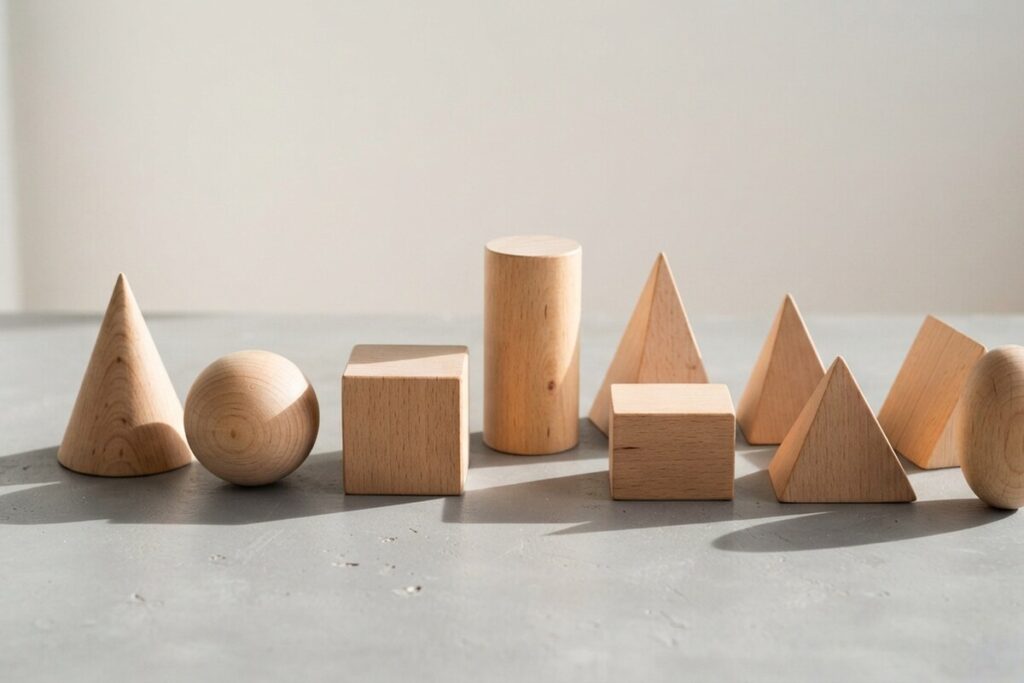
So two solids that can be rebuilt into each other must share the same Dehn invariant. A cube’s is zero. A regular tetrahedron’s, the pyramid made of four equal triangles, is not. However cleverly you slice a regular tetrahedron, you will never reassemble it into a cube of the same volume.
Among the five Platonic solids, only the cube has a Dehn invariant of zero. In 1965, Jean-Pierre Sydler closed the loop: two solids can be cut into each other exactly when both their volume and their Dehn invariant match.
Dehn was not quite alone. In 1882, a contest in Kraków had asked the very same question, and Ludwik Antoni Birkenmajer solved it another way. He never published, and his manuscript was only rediscovered years later.
From Hamburg to North Carolina, via Siberia
Dehn, born in 1878 to a family of Jewish origin, went on to co-write, with Poul Heegaard, the first book on the foundations of combinatorial topology in 1907. In 1935, he was forced to retire from his post in Frankfurt.
In January 1939 he fled to Copenhagen, then to Trondheim, Norway. By October 1940, crossing the Atlantic was considered too dangerous, so he reached America the long way: across Siberia and Japan.
After jobs in Idaho, Illinois and Maryland, he settled in 1945 at Black Mountain College, an experimental arts college in North Carolina. He was its only mathematician, and had negotiated his salary up from 25 to 40 dollars a month.
Geometry lessons in the woods
Invited to speak there in 1944, Dehn judged an advanced topic wrong for the audience and offered talks such as “Common roots of mathematics and ornamentics” instead.
There he taught mathematics, philosophy, Greek and Italian, plus a course called “Geometry for Artists”. He often held class in the forest, lecturing during hikes, and shared long breakfasts with Buckminster Fuller and his wife. He mentored the artists Dorothea Rockburne and Ruth Asawa.
He died in 1952 of an embolism, shortly after watching several dogwood trees being cut down on campus. He is buried in the woods there.
A question that is still open
Hilbert’s third problem looked like a puzzle for scissors and cardboard. It revealed that volume is far subtler than area. And the hunt is not over: in curved, non-Euclidean spaces, nobody yet knows if matching volume and matching Dehn invariant are always enough.