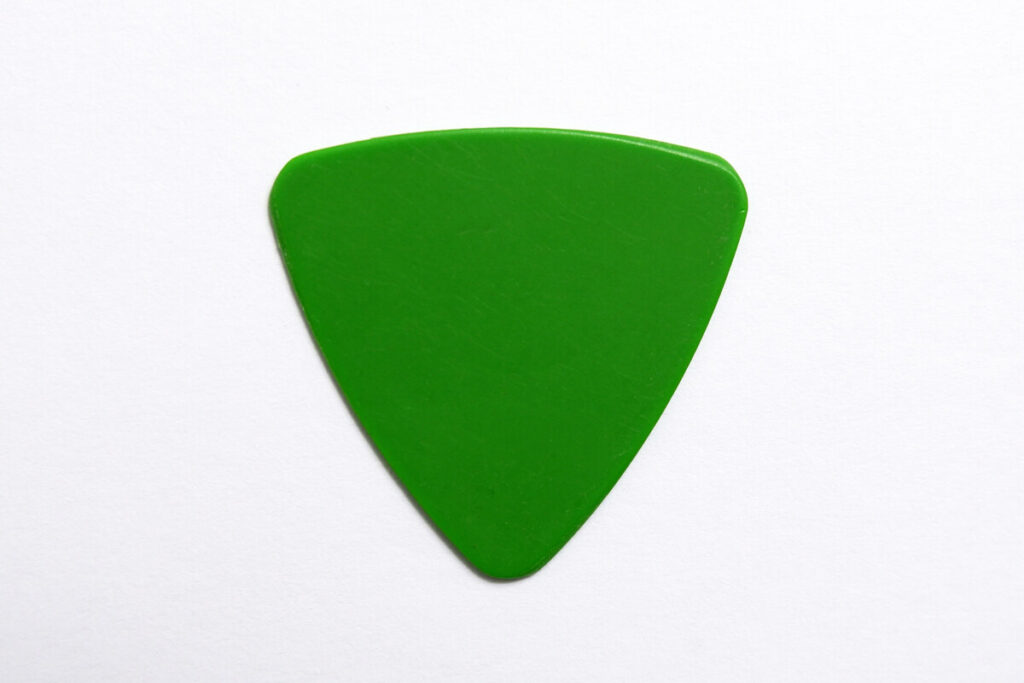
For centuries, the standard answer was that only a circle can make a manhole cover that never falls through its own hole, and a curved triangle with three sharp corners proves that answer wrong.
The shape that fits the same gap as a circle
It is called the Reuleaux triangle, and you can draw it with nothing but a compass. Mark two points, draw a circle around each through the other, then draw a third circle centered on one of the spots where the first two cross.
The small region where all three circles overlap is your shape. Each of its three sides is an arc, and each corner sits at the center of the opposite arc.
Its secret is something mathematicians call constant width. Press the shape between two parallel lines, turn it in any direction, and the gap between the lines never changes.
Why a manhole cover cannot drop through
A cover falls into its hole only if it can be tilted and slipped through along its narrowest direction. A shape with constant width has no narrow direction, so every way of measuring it gives the same answer.
That is why the Reuleaux triangle is the textbook response to the question of which shape other than a circle could work as a manhole cover. The circle was never special. It was just the best-known member of a larger family.
It is older than its name
Franz Reuleaux, a 19th-century German engineer, studied machines that turn one kind of motion into another, and the shape carries his name. He did not invent it.
Gothic church builders used it in window tracery from the late 13th or early 14th century, and some read its three corners as a symbol of the Trinity. Leonardo da Vinci used it around 1514 to flatten the globe into a world map made of eight curved pieces.
Leonhard Euler studied it mathematically in a paper presented in 1771 and published in 1781. He called such shapes “orbiforms”.
The strangest trick: drilling a square hole
Put a Reuleaux triangle inside a square and rotate it. It keeps touching all four sides the whole time, and no shape with that ability covers less area.
That property inspired the Watts Brothers square drill bit, patented by Henry Watts in 1914, although similar drills were used earlier. Mount a modified Reuleaux triangle in a special chuck that lets it wander off-center, and it cuts a hole that is almost perfectly square. Related shapes can drill pentagonal, hexagonal and octagonal holes.
It does leave tiny gaps near the corners, which is why the hole is only nearly square.
A terrible wheel and a clever lock
A constant-width shape rolls smoothly between two flat surfaces, so a board carried on rollers with this cross-section glides along without bouncing. Fix an axle to the middle of one, though, and the axle jumps up and down three times per turn. Science fiction author Poul Anderson built a short story around that problem, called “The Three-Cornered Wheel”.
The same oddity works as security. Some fire hydrant valve nuts use this cross-section, and an ordinary wrench with parallel jaws cannot grip it properly. Firefighters carry the special wrench, and passersby looking for free water do not.
Least area, same perimeter
Among all shapes of the same constant width, the Reuleaux triangle covers the least area. A circle covers the most. Yet every shape of that width shares exactly the same perimeter, which equals the width multiplied by pi.
So the sharp-cornered triangle and the perfectly smooth circle have the same distance around, even though one holds clearly less space inside.
A common mix-up worth fixing
The rotor of the Wankel engine is often described as a Reuleaux triangle. It looks like one, but its sides are flatter, so it does not have constant width.
It is a good reminder that a shape can resemble a famous curve without sharing the property that makes it famous.
What a circle was hiding all along
The circle is so familiar that it is easy to assume its tricks belong to it alone. The Reuleaux triangle shows that a property we link to roundness can live in a shape with corners, and that a drill, a pencil or a hydrant can quietly depend on it.