In 1611, Johannes Kepler wrote down what looked like the most obvious claim in geometry: the best way to stack balls is the pyramid you already have in mind. Proving it took until 1998, and checking that proof took until 2014.
The final version needed 250 pages of notes, 3 gigabytes of computer programs and data, and a team of 22 people. All for a pile of spheres.
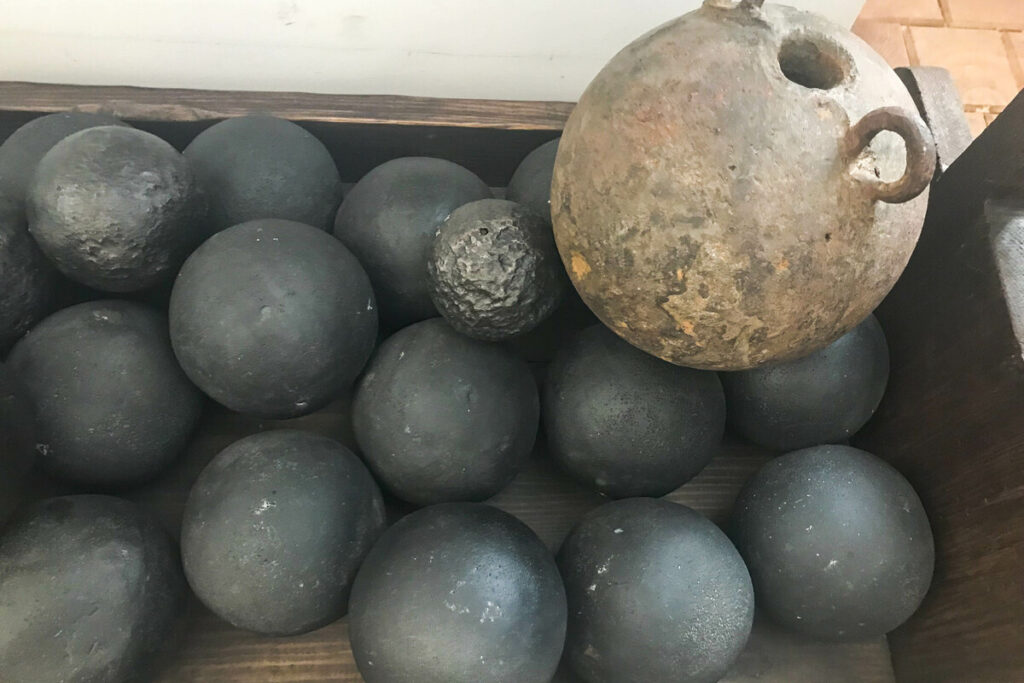
It started with a pile of cannonballs
The story begins with Sir Walter Raleigh. He asked his friend and assistant Thomas Harriot, an English mathematician and astronomer, to find formulas for counting cannonballs in a stack.
Harriot published a study of stacking patterns in 1591. That led to a deeper question: what is the best way to stack them in the first place? In 1606, he began writing to Kepler about it.
Five years later, Kepler put the answer in a short essay with a charming title, On the six-cornered snowflake. His claim: no arrangement of equal spheres can beat the familiar layered pyramid.
How full can a box of balls get
Fill a giant crate with identical balls and there will always be gaps. The question is how much space the balls themselves can take up.
If you simply pour the balls in at random, they fill only about 65% of the space. Kepler’s pyramid, where each layer nests into the hollows of the layer below, does much better: about 74.05% of the space is ball, and only a quarter is air.
Mathematicians even have an exact value for it, pi divided by the square root of 18. Kepler’s conjecture says nothing can do better.
The problem that refused to be obvious
Here is where the “obvious” claim got stubborn. In 1831, Carl Friedrich Gauss proved Kepler right, but only for regular arrangements, where every ball sits in a perfectly repeating grid.
That left the messy cases. Could some strange, irregular pile squeeze in a little more? Nobody could rule it out. In 1900, David Hilbert put the question on his famous list of 23 unsolved problems, as part of his 18th problem.
In 1953, László Fejes Tóth showed the problem could, in principle, be reduced to a finite number of calculations. The catch: far too many for any human. In 1958, Claude Ambrose Rogers proved no packing could beat about 78%, which still left a gap above Kepler’s 74%.
Then, in 1990, Wu-Yi Hsiang announced a proof. It did not survive scrutiny. A reviewer wrote, “As far as details are concerned, my opinion is that many of the key statements have no acceptable proofs.” Today his proof is considered incomplete.
A proof that humans could only call 99% certain
The breakthrough came from Thomas Hales at the University of Michigan. He turned the problem into a giant optimization task involving a function with 150 variables.
From 1992, with graduate student Samuel Ferguson, he used computers to check more than 5,000 possible sphere configurations, solving about 100,000 smaller math problems along the way. In 1996 he said the end was in sight but might take “a year or two.” In August 1998, he announced it was done.
The prestigious Annals of Mathematics handed the work to a panel of twelve referees. After years of checking, they reported in 2003 that they were “99% certain” the proof was correct, but they could not verify every computer calculation. The journal published the 100-page human-readable part in 2005.
Teaching a computer to check the whole thing
For Hales, 99% was not good enough. In January 2003, he launched a project called Flyspeck, a playful expansion of FPK, short for “Formal Proof of Kepler.” The goal was to have computer proof assistants check every single logical step.
In 2007, he estimated the job would take about 20 years. It took less. On August 10, 2014, the team announced that Flyspeck was complete. In 2015, Hales and 21 collaborators posted the full formal proof, which a journal accepted in 2017.
Why so much caution? Geometry has fooled experts before. In a related puzzle about dividing space into equal cells, a structure proposed by Lord Kelvin was believed to be the best for over 100 years, until a better one was found in 1993.
The pyramid was right all along
The flat version of the puzzle had been settled much earlier: in a plane, circles pack best in a honeycomb-like hexagonal pattern, a shape that also shows up in centuries-old tiling problems. And the story keeps going. In 2016, Maryna Viazovska found the perfect packing in 8 dimensions, which quickly led to a solution in 24 dimensions too.
A question about cannonballs ended up reshaping how mathematicians decide what counts as proof. Sometimes the most obvious answer is exactly the one that takes four centuries to earn.