
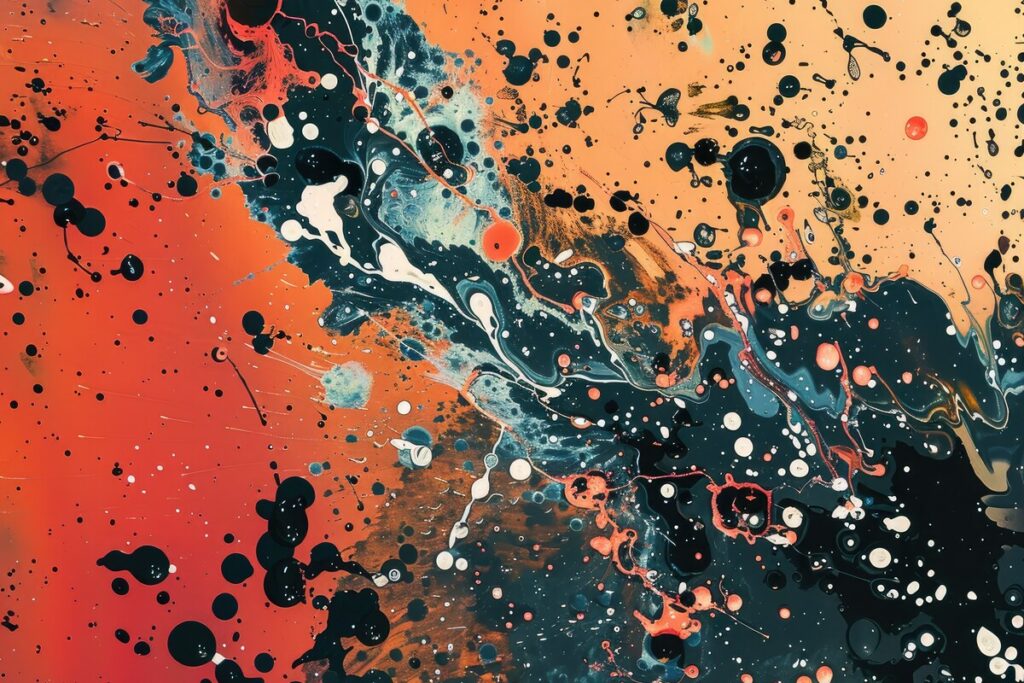
Since 1999, art experts have used a 19th-century math concept to test whether a painting was really made by Jackson Pollock, and the accuracy of that test now reaches 99 percent. The concept behind it is called a fractal, and it turns out to be hiding almost everywhere once you know what to look for.
The pattern hiding inside a splatter painting
More than 50 paintings attributed to Pollock have been run through fractal analysis since 1999. By 2015, the method could separate genuine works from imitations with 93 percent accuracy. By 2024, that number had climbed to 99 percent.
What the analysis actually measures is self-similarity, the tendency of a pattern to repeat itself, identically or approximately, at very different scales. Pollock’s drips apparently follow that logic closely enough that a forgery gives itself away.
A shape mathematicians said could not exist
The math behind this goes back to July 18, 1872, when the Prussian mathematician Karl Weierstrass presented the first formal definition of a fractal function: a curve that is continuous everywhere but smooth nowhere. At the time, the idea overturned how mathematicians understood curves.
In simple terms, a fractal is a shape that keeps revealing detailed structure no matter how far you zoom in. Ordinary curves eventually flatten into straight segments under enough magnification. Fractals never do. The word itself comes from the Latin fractus, meaning broken or fragmented.
Snowflakes, triangles and a word invented in 1975
After Weierstrass, the idea kept resurfacing. Georg Cantor published his now-famous sets in 1883, one of the earliest mathematical fractals on record. In 1904, Swedish mathematician Helge von Koch introduced the Koch snowflake, a shape so jagged that, in theory, tracing its edge completely would require an infinite length.
Wacław Sierpiński added his own constructions in 1915 and 1916, the Sierpinski triangle and the Sierpinski carpet, both still used to teach the concept today. None of these shapes shared a common name until 1975, when Benoit Mandelbrot coined the term fractal and produced computer visualizations striking enough to make the concept famous almost overnight.
Villages built like fractals long before the word existed
Centuries before any of this was formalized, traditional architects in West Africa were already designing with fractal scaling instinctively. Entire villages were laid out as circles made up of smaller circular clusters, made up of individual circular houses. Nobody called it a fractal. It simply worked.
That points to a common misconception about fractals: the idea that they are purely abstract, with no connection to the real world. In fact, they turn up constantly in nature, in tree branches, coastlines and snowflakes, and even inside the human body, in the branching of neurons and blood vessels.
Not every fractal is a perfect copy of itself
It is tempting to picture a fractal as an endless, exact copy of itself at every scale, the way a Koch snowflake or a Menger sponge behaves in pure mathematics. Most fractals found in nature are not that tidy. They usually show only statistical or approximate self-similarity, close enough to the same pattern without being a flawless repetition.
That distinction even reached literature. Novelist David Foster Wallace said the first draft of Infinite Jest was structured directly after the Sierpinski triangle, though he later described the published version as closer to what he called an asymmetrical Sierpinski Gasket.
A shape that keeps showing up where you least expect it
From a 19th-century curve nobody could measure to a tool that now authenticates paintings worth millions, fractals quietly connect a surprising number of dots. Once the pattern is pointed out, it becomes hard to stop noticing it, in a fern, in a coastline, in a canvas covered in dried paint.