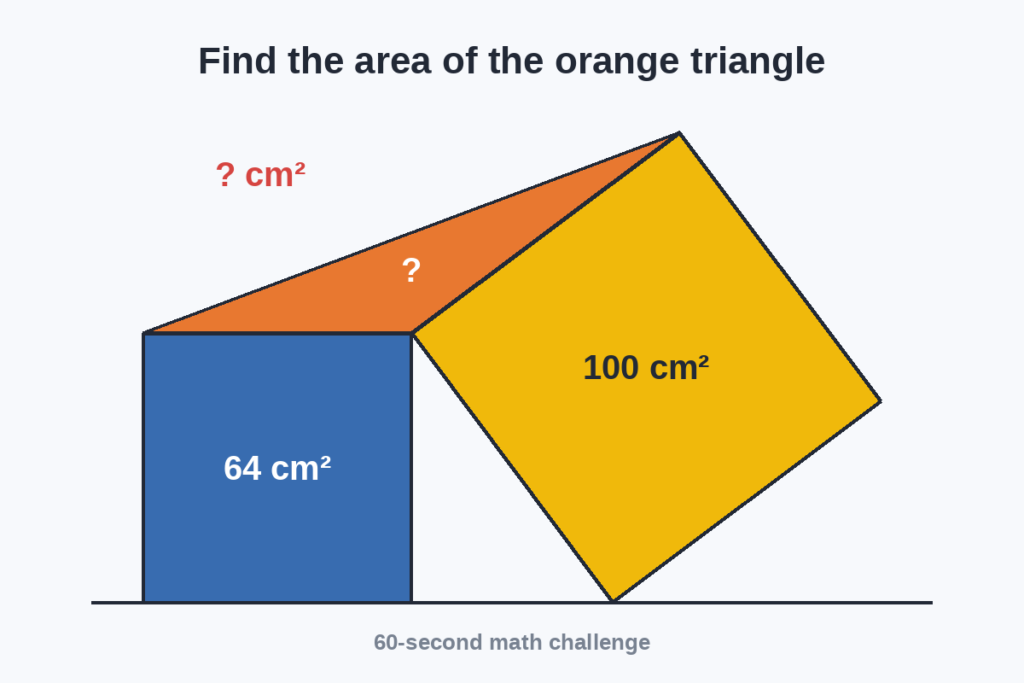
Two squares, one orange triangle and not a single length written on the triangle itself. The only clues are the areas of the two squares, and you have 60 seconds to work out how much space the triangle covers.
A forgotten plan with a missing number
Picture an old manor house whose building plans have just turned up at the back of a dusty library. On one sheet, the architect sketched two squares of different sizes leaning against each other, with a small triangle tucked on top. Every other surface on the drawing is labeled, but the triangle is blank. A short note in the margin claims that everything you need is already on the page.
That kind of note is a classic in geometry. Builders, surveyors and engineers rarely get every measurement handed to them. More often they know a few facts and have to deduce the rest from how the shapes fit together. That is exactly the situation in today’s challenge.
Many people start this kind of puzzle by trying to measure every side one by one. The faster route is to look at how the figures touch each other: one well-chosen property can unlock the whole drawing.
Given information
- A square stands on the ground on the left. Its area is 64 cm².
- A second, tilted square leans against the top right corner of the first one, with its lowest corner resting on the ground. Its area is 100 cm².
- The orange triangle sits on top of the first square: its base is the top side of that square, and its tip is the highest corner of the tilted square.
- Your mission: find the area of the orange triangle.
- Time limit: 60 seconds.
What this challenge trains
This puzzle asks you to move back and forth between areas and lengths, to spot a right triangle hidden between two shapes, and to use the Pythagorean theorem to recover a missing side. It also tests a subtler skill: noticing that a tilted square turns one known triangle into a second, identical one. Above all, it rewards observation over brute force, since picking the useful information matters more than piling up calculations.
Ready? The clock is running
60… 50… 40… 30… 20… 10… 5, 4, 3, 2, 1… Time is up!
Found it in under a minute? Your spatial reasoning is in great shape. Needed a bit longer? That is perfectly normal for a figure with no visible lengths. Stuck? The walkthrough below breaks it down into five short steps.
Step 1: the side of the first square
The area of a square is its side multiplied by itself. To go back from the area to the side, take the square root.
Side = 8 cm
Each side of the left square is 8 cm long. That includes its top side, which is also the base of the orange triangle.
Step 2: the side of the tilted square
Same idea for the second square.
Side = 10 cm
Each side of the tilted square measures 10 cm. Its lower left side runs from the top right corner of the first square down to the ground.
Step 3: the hidden right triangle on the ground
Look at the gap between the two squares. The right side of the first square (8 cm, vertical), the ground (horizontal) and the lower left side of the tilted square (10 cm) form a right triangle. Call its horizontal side d and apply the Pythagorean theorem.
100 = 64 + d²
d² = 100 − 64
d² = 36
d = 6 cm
So the lowest corner of the tilted square touches the ground 6 cm to the right of the first square. You may recognize the famous 6, 8, 10 triangle, a scaled-up version of the 3, 4, 5 triangle.
Step 4: the height of the orange triangle
This is the key move. Going down its lower left side, the tilted square travels 6 cm horizontally and 8 cm vertically. Its upper left side is perpendicular to that side and has the same length, so it simply swaps the two numbers: it travels 8 cm horizontally and 6 cm vertically.
That upper left side starts at the top right corner of the first square and ends at the highest corner of the tilted square, which is the tip of the orange triangle. Since the base of the triangle is horizontal, its height is exactly that vertical rise.
Step 5: the area of the orange triangle
Now apply the classic formula for the area of a triangle.
Area = (8 × 6) ÷ 2
Area = 48 ÷ 2
Area = 24 cm²
The orange triangle covers 24 cm².
Quick recap
- Side of the first square: 8 cm
- Side of the tilted square: 10 cm
- Gap on the ground: 6 cm
- Height of the orange triangle: 6 cm
- Base of the orange triangle: 8 cm
- Area: (8 × 6) ÷ 2 = 24 cm²
Why this puzzle is trickier than it looks
The triangle seems to come with no data at all, so the natural reflex is to give up or to guess. The trick is that the two areas are really lengths in disguise, and that a tilted square always carries the same right triangle twice, once on each of two neighboring sides, rotated by a quarter turn. Once you see that, the height falls out with no extra calculation.
Surveyors and architects rely on exactly this kind of indirect reasoning when they need a surface they cannot measure directly. So, did you land on 24 cm² before the 60 seconds ran out, and did you spot the 6, 8, 10 triangle right away?