
A frog at the bottom of a deep well, a patient climb every day and an annoying slide every night: this classic puzzle looks like a two-second division, yet it has tricked generations of quick thinkers. Can you count the days correctly before the timer runs out?
Frogs are surprisingly good athletes. Their powerful hind legs let them leap many times their own body length, clear obstacles and escape predators in a flash. Now picture one unlucky frog that has tumbled to the very bottom of an old stone well. Jumping straight out is impossible, so she has to climb, slowly and stubbornly, one stretch of wall at a time.
Every morning she sets off with fresh energy and gains some height. Every night, tired and on slippery stones, she loses part of what she gained. The question is simple: how long will it take her to see the sky again? The answer hides a small detail that changes everything, and that is exactly what makes this puzzle such a good logic workout.
The challenge
Here is everything you need to know about the frog and her well:
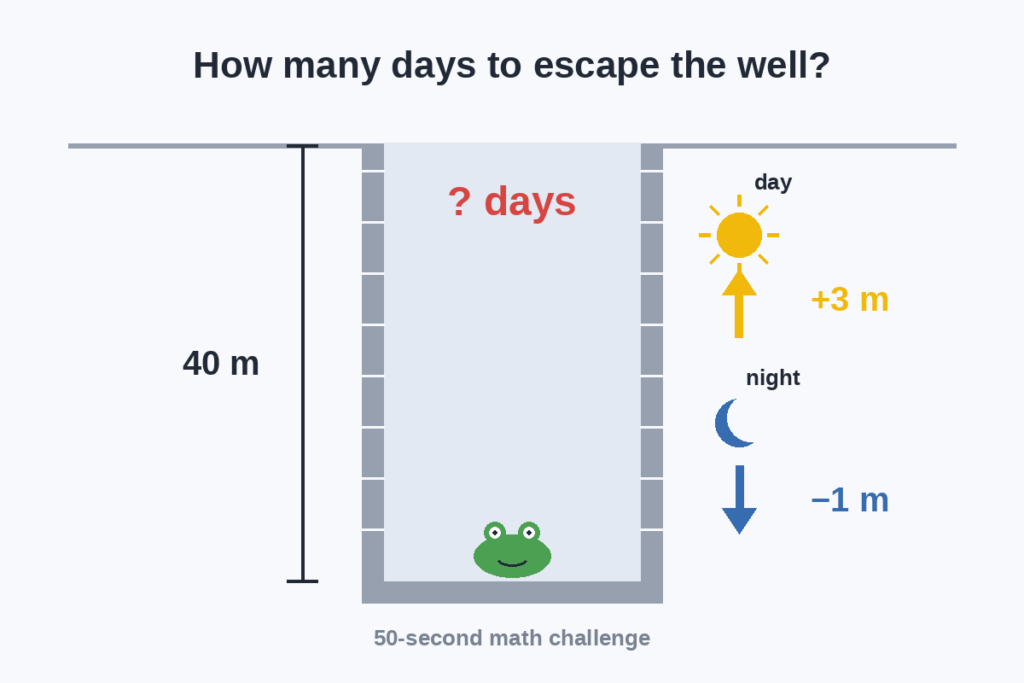
- Depth of the well: 40 meters
- During each day: the frog climbs up 3 meters
- During each night: she slides back down 1 meter
- Question: on which day does the frog get out of the well?
Be careful, there is a trap waiting for anyone who calculates too fast. Look closely at what happens on the very last day. You have 50 seconds. Ready? Go!
50… 40… 30… 20… 10… 5… 4… 3… 2… 1… Time is up!
What this challenge trains
This puzzle works on logical reasoning about a situation that changes over time. You have to compute a daily net gain, keep day and night movements separate, and organize the information with a simple inequality. Above all, it teaches you to spot an exception: the final day does not behave like all the others.
It also builds patience and the habit of double-checking a result before announcing it. A calculation can be perfectly correct on paper and still answer the wrong question if the situation is misread. That skill matters well beyond math, whenever you estimate a duration, a distance or the number of steps needed to reach a goal.
How did you do?
- Right answer, found quickly: you have sharp logic and a strong eye for detail.
- Right answer after some thought: you know how to structure a reasoning and check each step.
- Wrong answer or no answer: no worries, puzzles like this one are the best way to sharpen your method.
Step-by-step solution
Step 1: work out the net progress per full cycle
During the day the frog climbs 3 meters, and during the night she slips back 1 meter. Over one complete day-and-night cycle, her real progress is:
Step 2: why the quick division is a shaky shortcut
The tempting move is to divide the depth by the net gain:
This shortcut treats every day the same way, as if the frog always slid back at night. But once she reaches the top during the day, she is free: there is no final night of slipping. The last climb must be handled separately, so this division cannot be trusted on its own, even if the number it gives looks plausible.
Step 3: find the height she needs before her last climb
To get out, the frog must reach 40 meters. Since she can climb 3 meters in a single day, she only needs to start her final morning at least 37 meters up:
Step 4: count the full cycles needed
Let n be the number of complete day-and-night cycles before the final climb. Each cycle adds 2 meters, so we need:
n ≥ 18.5
A cycle cannot be split in half, so we round up to the next whole number: 19 complete cycles. After those 19 cycles, the frog starts the next morning at 38 meters, which is enough. Her escape therefore happens during day 20.
Step 5: follow the frog to the top
After the first day and night, she is 2 meters up. After 10 cycles she has gained 20 meters, and after 18 cycles she sits at 36 meters. On day 19 she climbs to 39 meters, still short of the rim, so she slides back to 38 meters during the night. On the morning of day 20 she starts at 38 meters, needs only 2 more meters and can climb 3: she reaches the top during the day and never has to face another night in the well.
Step 6: check the result
Day 19: 36 + 3 = 39 meters, night 19: 39 − 1 = 38 meters
Day 20: 38 + 3 = 41 meters ≥ 40 meters, she is out
Everything adds up. The trap was to apply the nightly slide even after the frog had already escaped. Here, the quick guess of 20 happens to land on the right number, but only the careful reasoning above actually proves it.
Final answer
The frog climbs out of the well during day 20. She spends 19 nights in the well and reaches the surface during her twentieth day, with no need to slide back after her final climb.
Every detail counts
This little story shows how a puzzle that looks trivial can hide a subtler line of reasoning. The frog gains 2 meters per full day and night, but her final climb follows its own rule, and that is what explains her escape on day 20. Math is not only about adding, subtracting or solving equations: it is also about reading a situation carefully, anticipating what happens next and identifying the information that really matters, whether you are planning a trip, a project or a budget.
There is a gentle lesson in perseverance too. Even when progress feels slow and setbacks keep coming, every step brings you closer to the goal. Did you find day 20 before the countdown ended, or did you simply divide 40 by 2? Share this challenge with friends and see who can explain the reasoning the fastest.