Imagine a young woman who refuses to give up on her dream of becoming a mathematician, even though the odds are stacked against her. In an era when women rarely had access to scientific education, she spends her evenings studying equations and solving problems that most people consider impossible. That woman is Sophie Germain, a French mathematician whose determination quietly changed the course of science.
Germain was especially drawn to number theory and to problems that looked unsolvable at first glance. To get her work taken seriously in a field almost entirely closed to women, she even corresponded under a male pseudonym. Her story is a reminder that mathematics is not only about raw talent, it is also about persistence, curiosity and self confidence.
Today, mathematics shows up in almost every part of our lives. It teaches us to think with method, to spot hidden relationships, and to untangle situations that look complicated at first. Sometimes, a handful of simple shapes is all it takes to reveal the quiet power of logical reasoning.
“It is impossible to be a mathematician without having the soul of a poet.” (Sofia Kovalevskaya)
That quote is a good reminder that mathematics takes as much imagination as it does logic. Solving a problem often means looking at it from a different angle, and noticing a relationship no one pointed out to you. Creativity helps you find the path, reasoning helps you prove it is correct. That mix of imagination and rigor is exactly what makes a good puzzle so satisfying.
Given information
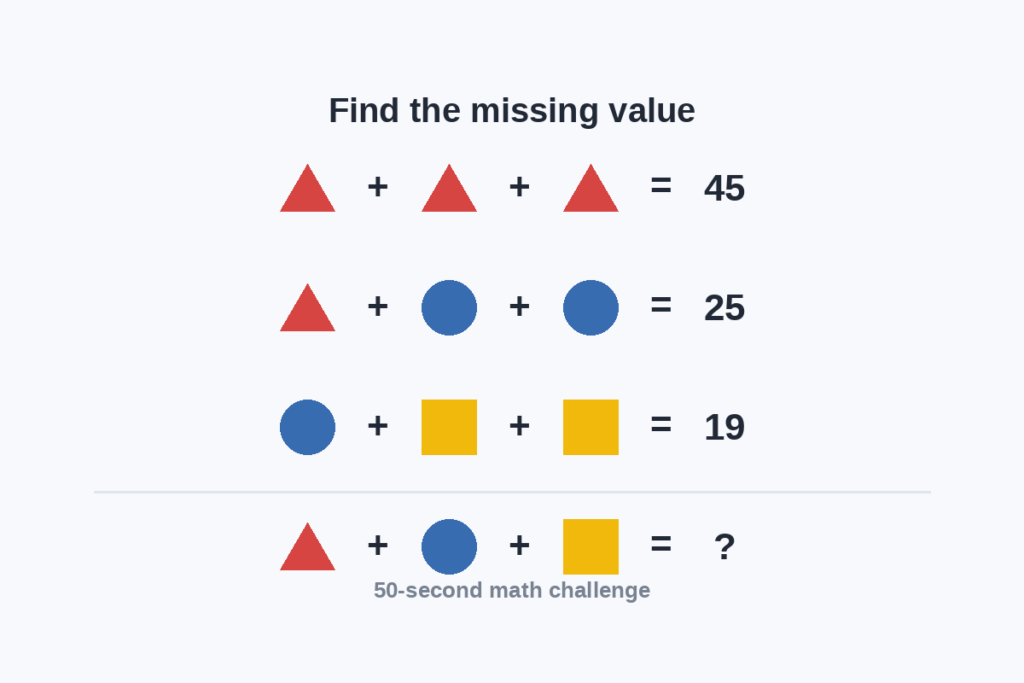
- Three red triangles, stacked together, add up to 45
- One red triangle plus two blue circles add up to 25
- One blue circle plus two yellow squares add up to 19
- Find the value of: one triangle + one circle + one square
You have 50 seconds on the clock. Look closely at the three equations above and figure out which one to start with. The trick is to solve them in the right order, not the order they are written in.
What this challenge trains
This kind of puzzle sharpens your sense of observation and your ability to spot relationships between several unknowns at once. It trains you to solve simple equations using addition, subtraction and division, while keeping your information organized in the right order. It also rewards patience: the final answer only shows up once every earlier step has been checked.
Step-by-step solution
Step 1, find the triangle. The first equation has three identical red triangles adding up to 45. Since all three are equal, dividing the total by three gives the value of one triangle.
45 ÷ 3 = 15
Red triangle = 15
Step 2, find the circle. The second equation has one triangle and two circles. Since the triangle is now worth 15, substitute it in.
15 + Circle + Circle = 25
Circle + Circle = 10
10 ÷ 2 = 5
Blue circle = 5
Step 3, find the square. The third equation has one circle and two squares. Substitute the circle’s value of 5.
5 + Square + Square = 19
Square + Square = 14
14 ÷ 2 = 7
Yellow square = 7
Step 4, calculate the final answer. The last equation asks for one triangle, one circle and one square added together.
15 + 5 = 20
20 + 7 = 27
Checking the answer
Before trusting a result, it is always worth plugging the numbers back into the original equations.
15 + 5 + 5 = 25, correct.
5 + 7 + 7 = 19, correct.
All three equations check out, which confirms the final answer.
Final answer: 27
The red triangle is worth 15, the blue circle is worth 5 and the yellow square is worth 7. Adding the three together gives 15 + 5 + 7 = 27. The key to this puzzle was starting with the equation that had only one unknown, then using each new value to unlock the next one.
A closing thought
This challenge is a small reminder that in mathematics, success usually depends more on method than on speed. By moving one careful step at a time, you can turn a puzzle that looks confusing at first glance into a result you can prove is correct. Like Sophie Germain and so many other passionate mathematicians before us, the goal is not to find the answer instantly, it is to learn how to keep going when it does not appear right away. A difficulty is not a reason to give up, it is an invitation to look at the problem from another angle.
So, did you find 27 before the clock ran out? If you did, congratulations on your speed and logic. If not, hold on to the method you just used, it will come in handy on the next challenge.