Three square roots, one fraction and a clock ticking down from 30. This calculation looks intimidating at first glance, yet it collapses into a single whole number once you know where to start. The real catch hides in the two roots stacked inside each other.
Square roots are far more than a school exercise. Engineers use them to work out distances, physicists rely on them to describe waves and energy, and every GPS receiver in your pocket handles them constantly. Still, the moment several root symbols appear in the same line, many people freeze and assume the problem is beyond them.
Take Maya, a seventh grader who was perfectly comfortable with multiplication tables but dreaded anything with a radical sign. One morning her teacher wrote a fraction full of roots on the board, and Maya immediately decided she could not do it. Instead of handing her the answer, the teacher asked a single question: “Which part of this can you already solve?” Maya spotted one root she recognized, turned it into a plain number, then another, and a few minutes later she had the final result without touching a calculator. The difficulty was never in the numbers, only in the order she tackled them.
That is exactly the spirit of today’s challenge.
The challenge
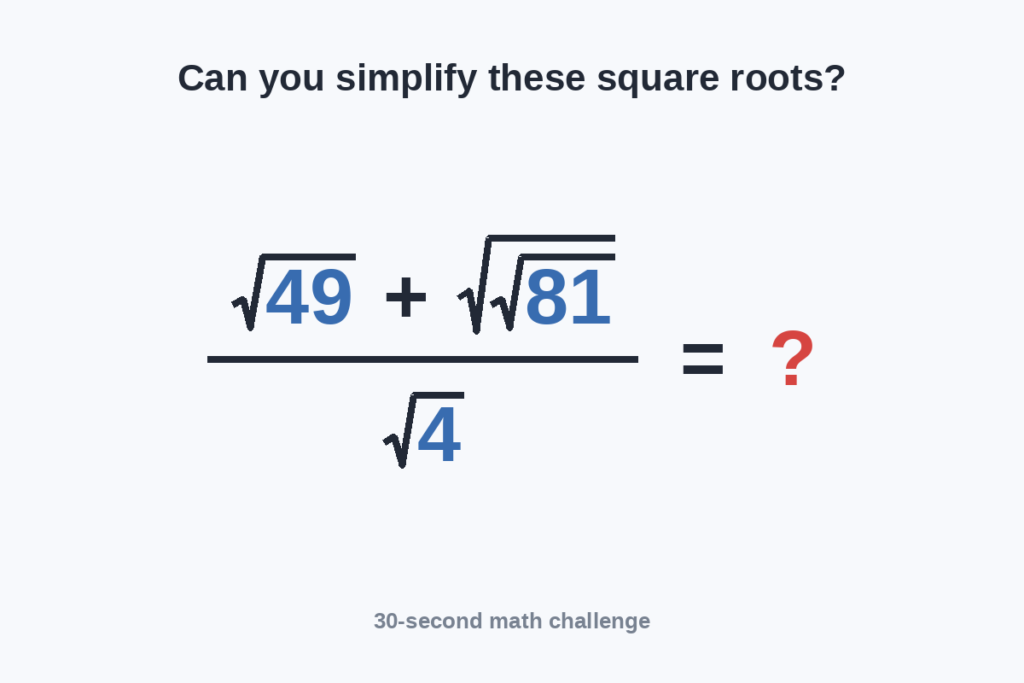
Here is the calculation you need to solve in 30 seconds, mentally if possible:
Given information:
- The numerator is the sum of two terms: √49 and √(√81)
- The second term contains two nested square roots: the square root of the square root of 81
- The denominator is √4
- You must find the single value of the whole fraction
Look closely at the nested roots before you start. Ready? Start your timer.
What this challenge trains
This puzzle sharpens your grasp of square roots and, above all, the difference between a single root and a root placed inside another one. It also reinforces the order of operations: simplify each piece of a fraction before dividing. Finally, it builds the habit of checking your result, which is the best protection against mistakes made in a rush.
Step 1: read the structure of the calculation
We are looking at a fraction. On top, an addition of two terms that both contain roots. Underneath, a much simpler root. The cleanest strategy is to simplify the numerator term by term, then the denominator, and only then perform the division.
Step 2: the square root of 49
The principal square root of a positive number is the positive number that, multiplied by itself, gives the starting value. Which number times itself equals 49?
√49 = 7
The first term of the numerator is done.
Step 3: the nested roots, where the trap lies
Two roots in a row means you work from the inside out. First the inner root:
√81 = 9
Then the outer root, applied to that result:
√(√81) = √9 = 3
The classic mistake is to stop at 9 and forget the second root. Anyone who does that ends up with a numerator of 16 and a final answer of 8, which is wrong.
Step 4: the numerator
Both terms of the numerator are now plain numbers, so we simply add them:
Step 5: the denominator
The bottom of the fraction holds √4. Since 2 multiplied by itself gives 4:
√4 = 2
Step 6: the final division
Our impressive-looking calculation has shrunk to an elementary division:
Check the answer
Let’s replay the whole calculation in one go, replacing each root by its value and keeping the order of operations:
= (7 + √9) ÷ 2
= (7 + 3) ÷ 2
= 10 ÷ 2
= 5
Every root has been handled, nothing has been skipped, and the result holds. The correct answer is 5.
When symbols look scarier than they are
This challenge proves that a calculation can look complex and still be simple once the right rules are applied in the right order. The nested roots were the only real obstacle, and they gave way as soon as we worked from the innermost one outward. Breaking a problem into small, manageable steps is a habit that pays off far beyond math homework, in science, technical jobs and everyday decisions alike.
So, did you reach 5 before the 30 seconds ran out? If you hesitated, remember the key takeaway: always start with the innermost root. Share the puzzle with friends and family to see who falls into the trap of stopping at 9.