A four-dimensional cube is impossible to build, impossible to hold and impossible to see. Yet over the past 140 years, this shape has slipped into a famous painting, a Paris landmark, a science fiction story and even a video game.
First, what is a tesseract
A tesseract is to a cube what a cube is to a square. Take a square, push it into a new direction and you get a cube. Do the same thing with a cube, in a fourth direction we cannot picture, and you get a tesseract.
Its numbers are surprisingly tidy. A tesseract has 16 corners, 32 edges, 24 square faces and 8 cubes as its “walls”, all meeting each other at right angles. And if every edge is one unit long, the longest diagonal, from one corner to the opposite one, is exactly two units long.
It is also a member of a very exclusive club. Only six regular convex shapes exist in four dimensions, and the tesseract is one of them.
1. A word invented by a British writer in 1888
The name did not come from a university lecture hall. It came from Charles Howard Hinton, a British mathematician and writer who spent his career trying to make the fourth dimension feel concrete.
In his 1888 book A New Era of Thought, he introduced the word, spelled “tessaract” at the time. By 1904, in The Fourth Dimension, he had settled on the spelling we use today.
The word itself comes from ancient Greek: téssara means four and aktís means ray. That is a fitting picture, since four edges leave every corner of the shape.
2. A Salvador Dalí painting from 1954
In 1954, Salvador Dalí painted Corpus Hypercubus, a crucifixion scene with a twist. The cross is not made of two wooden beams. It is a tesseract unfolded into three dimensions, a stack of eight cubes.
Think of how a cardboard box can be cut and flattened into a cross of six squares. Dalí did the same thing one dimension higher. That particular unfolding is now known as the “Dalí cross”.
3. A house that folded itself up in 1940
Science fiction got there even earlier. In Robert Heinlein’s 1940 short story And He Built a Crooked House, an architect builds a home shaped like an unfolded tesseract.
Then an earthquake hits. The building collapses, not into rubble, but into its true four-dimensional form, folding itself up into a shape the people inside can barely make sense of.
4. A giant arch in the heart of Paris
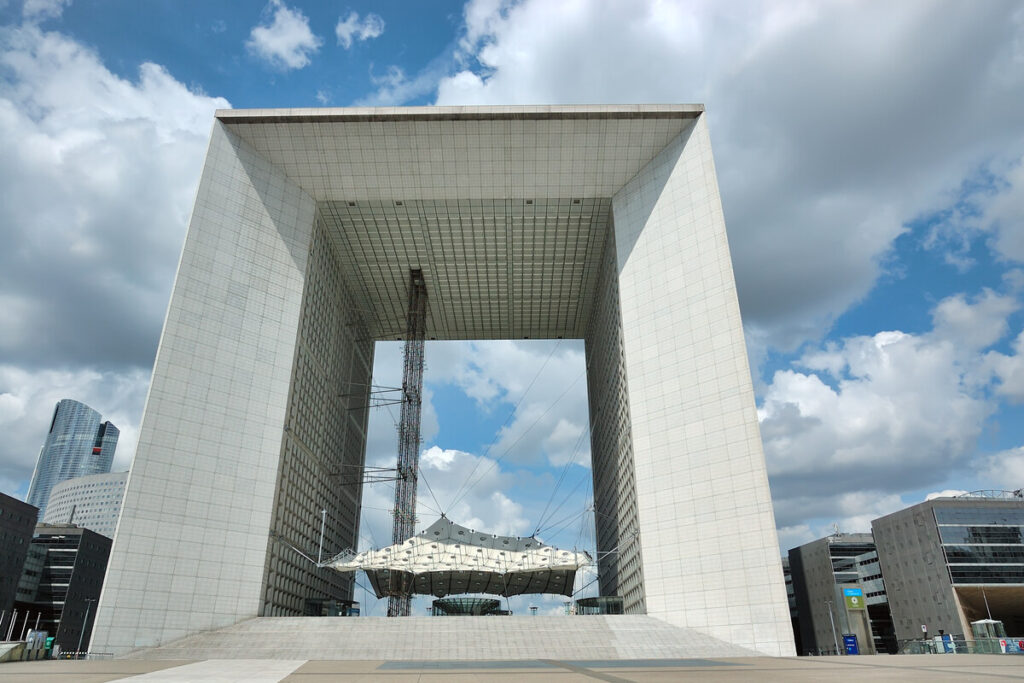
You can actually walk up to the most famous tesseract in the world. The Grande Arche de la Défense, inaugurated in Paris in 1989, was designed by engineer Erik Reitzel to evoke the three-dimensional projection of a tesseract.
In other words, a Paris landmark is built around an object that cannot fully exist in our space.
5. A tiny guide in the video game Fez
In the independent video game Fez, the player is accompanied by a character named Dot. Dot is, quite literally, a tesseract.
Its job fits its shape perfectly. Dot helps the player move through dimensions that would normally stay hidden, a playful nod to the idea that some worlds are just out of view.
The one place you will never find it
Here is the catch behind all five examples. No one has ever seen a real tesseract, and no one ever will. It is not a hidden object floating somewhere in space. It is a purely abstract shape, and humans can only ever look at its shadows, projected down into two or three dimensions.
Even the vocabulary is a little slippery. When people say “hypercube” without naming a dimension, they usually mean the tesseract specifically, not any cube beyond the third dimension.
Dalí’s cross, Heinlein’s house and the arch in Paris are all just shadows of the same thing. That may be the strangest part of the story: a shape nobody can see has been showing up in plain sight for well over a century.