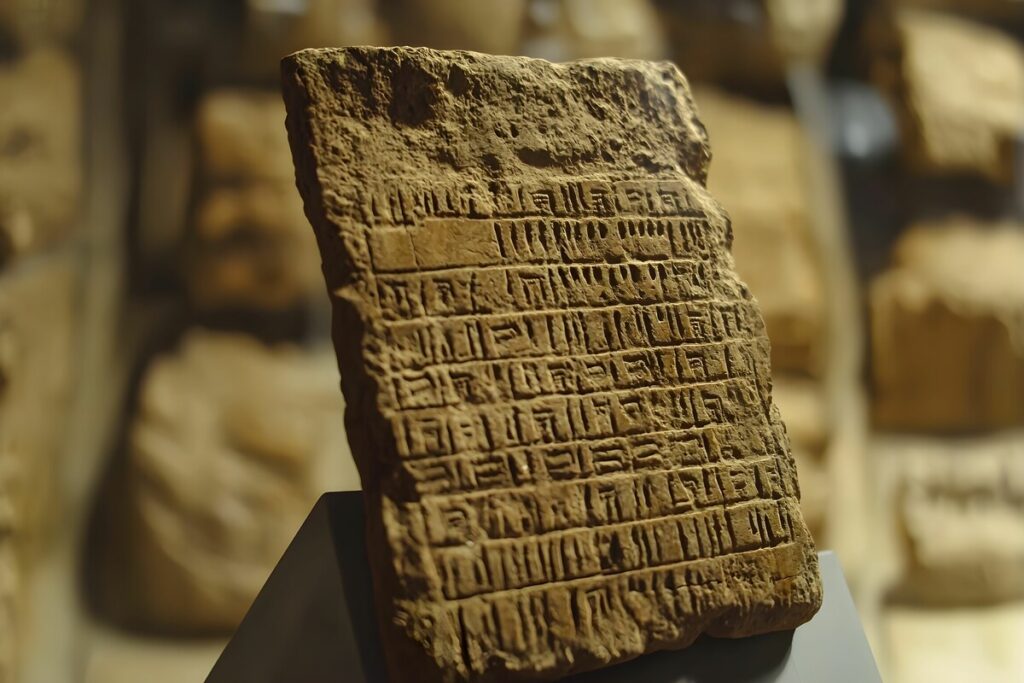
The theorem named after Pythagoras was already being used a thousand years before he was even born.
It is one of the most famous rules in mathematics, and the story most people learn along with it is not quite true. Pythagoras almost certainly did not discover the relationship that carries his name.
A thousand years too late for the credit
No source from Greek antiquity, written in the five centuries following his death, directly credits Pythagoras with the theorem. Only much later did the writers Plutarch and Cicero explicitly attach his name to it. Meanwhile, the Babylonian tablet known as Plimpton 322 lists fifteen different sets of whole numbers satisfying the relationship, and it predates Pythagoras by roughly a thousand years.
The Egyptian Berlin Papyrus 6619, dated to around 1800 BCE, already contains a problem involving the numbers 6, 8 and 10, a working example of the same rule. Indian texts called the Shulba Sutras, attributed to Baudhayana and composed between the 8th and 5th centuries BCE, describe both the general case and a special isosceles version.
What the theorem actually says, without the formula
In any right triangle, there is a fixed relationship between the length of the longest side and the two shorter sides that meet at the right angle. Combine the areas built on each of the two shorter sides, and the result always matches the area built on the longest side exactly.
Sets of whole numbers that satisfy this relationship, like 3, 4 and 5, or 5, 12 and 13, are called Pythagorean triples. Around 300 BCE, Euclid gave the first fully rigorous, step by step proof of the theorem in his Elements, along with a formula for generating every possible triple.
A theorem with more than 370 known proofs
According to the reference work The Pythagorean Proposition, this single result has been proven in at least 370 different ways, ranging from geometric rearrangement to purely algebraic arguments to methods borrowed from calculus.
Some of those proofs come from unexpected places. Before he ever held political office, future United States president James Garfield published his own original proof, based on the area of a trapezoid. Albert Einstein also devised a proof of his own, one that requires nothing more than dropping a single perpendicular line from the right angle, with none of the pieces needing to move.
A drowning, a spiral, and a theorem that never stopped multiplying
Legend holds that Hippasus of Metapontum, around 470 BCE, was drowned at sea after revealing that some lengths simply cannot be expressed as a ratio of whole numbers, a discovery that clashed violently with Pythagorean beliefs about numbers.
The theorem’s influence stretches into places that have nothing to do with triangles on paper. The spiral of Theodorus, built from a chain of right triangles, produces line segments whose lengths trace out the square roots of every positive whole number, one after another. Even complex numbers rely on the same relationship, since the distance of a point from the origin depends on exactly the same sum of squares Pythagoras is remembered for.
A theorem born from land measurement thousands of years before Pythagoras still shapes how distance itself is calculated, in triangles, in spirals, and in mathematics far beyond anything the ancient world could have imagined.