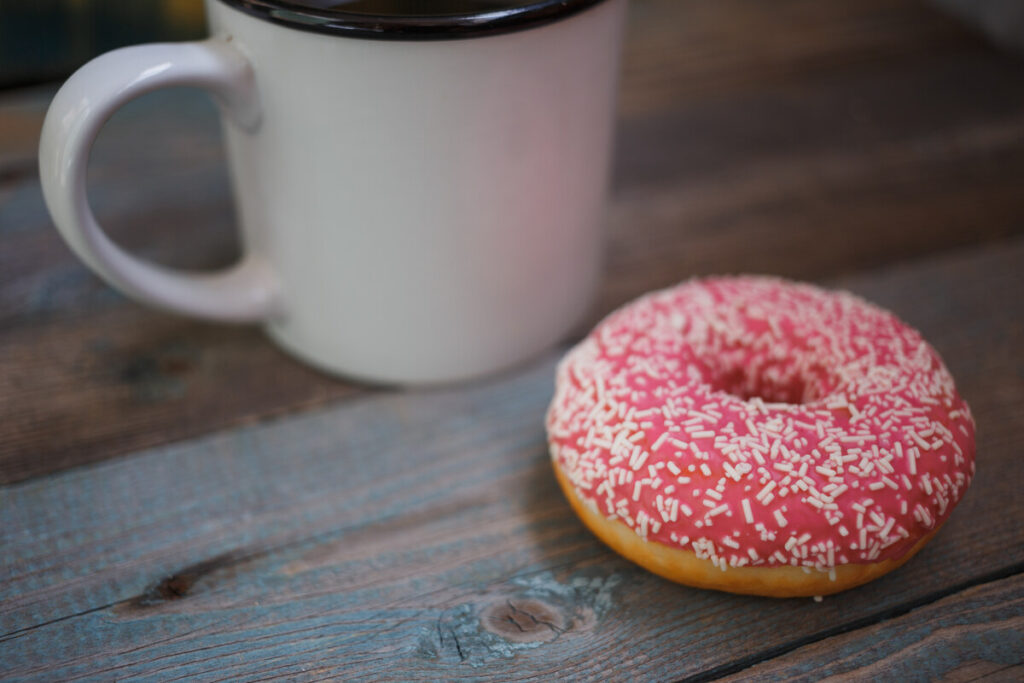
To a mathematician, the mug holding your morning coffee and the donut sitting next to it are not two different objects: they are the same shape.
That sounds like a joke, but it is the founding idea of a whole branch of mathematics called topology. Once you understand the one rule behind it, the idea stops sounding absurd.
The math that lets you stretch but never tear
Topology studies the properties of shapes that survive continuous deformation. You are allowed to stretch an object, twist it or crumple it as much as you like. What you can never do is tear it apart or glue two pieces together.
That single rule changes everything. Lengths, angles and exact curves stop mattering. What counts is whatever stays true no matter how much you squish the object, like whether it is in one piece or how many holes run through it.
Many people assume topology is just classic geometry with fancier vocabulary, obsessed with precise shapes and measurements. It is almost the opposite: topology deliberately ignores the exact form of an object and keeps only what no amount of bending can change, without ever opening or closing a hole along the way.
How a donut quietly becomes a coffee cup
The classic illustration is nicknamed the topologist’s breakfast. Picture a donut made of soft, flexible clay. Press a small dimple into its surface, then keep widening it until it becomes the bowl of a cup.
While the dimple grows, the rest of the ring slowly shrinks. The hole in the middle never disappears. It simply ends up as the hole in the handle. No tearing, no gluing, so for a topologist the two objects are equivalent.
The technical name for this most basic kind of shape-preserving transformation is a homeomorphism. Mathematicians also work with a looser, more complex version called homotopy equivalence, but the spirit is the same: two shapes count as “the same” if one can be smoothly reshaped into the other.
A bridge puzzle started it all in 1736
Topology feels like a modern invention, but it grew out of a walking puzzle. The city of Königsberg had seven bridges, and the question was simple: could anyone take a stroll that crossed each bridge exactly once?
In 1736, Leonhard Euler proved that it was impossible. The answer had nothing to do with how long the bridges were or how far apart they stood. Only the way they were connected mattered. That result is considered the first practical theorem of topology, and it also gave birth to graph theory.
Euler kept pulling on that thread. On November 14, 1750, he wrote to a friend about the importance of the edges of a polyhedron. That reflection led to his famous rule for solids: count the corners, subtract the edges, add the faces, and you get 2.
Who actually gave the field its name
The word itself arrived a century later. Johann Benedict Listing officially introduced “Topologie” in 1847 in his book Vorstudien zur Topologie, after using it in his private letters for almost ten years.
In 1895, Henri Poincaré published Analysis Situs, introducing the ideas of homotopy and homology and founding modern algebraic topology almost single-handedly. Felix Hausdorff coined the phrase “topological space” in 1914, and Kazimierz Kuratowski generalized its definition in 1922 into the form mathematicians still use today.
Even so, calling topology a purely 20th-century science is a myth. The field was formalized then, but its conceptual roots go back to the 17th century, with Leibniz and his ideas of geometria situs.
Shapes that refuse to behave
Topology is full of results that sound like party tricks. The most famous is the hairy ball theorem. It says you can never comb the hair on a hairy ball perfectly flat: somewhere, there will always be at least one cowlick.
In more formal terms, it is impossible to cover a sphere with tiny arrows that all lie flat along the surface, change smoothly from point to point, and never shrink to zero. At least one spot always breaks the pattern.
Then there is the Möbius strip, one of the most studied objects in the field. It has only one surface and only one edge, a clear sign of how far topological properties can drift from everyday geometric intuition.
What survives when everything else bends
Strip away lengths, angles and exact curves, and a few properties still hold firm. Topologists rely on three fundamental ones to tell objects apart: dimension, compactness and connectedness.
It all started with seven bridges and a question about a walk, and it proves something worth remembering: sometimes the most important thing about a shape is not what it looks like, but how it holds together.