The American mathematician Leonard Dickson once boasted that his favorite branch of mathematics had no practical use at all. A few decades later, that same branch became the foundation of public-key cryptography, used every day around the world.
The branch is number theory, the study of whole numbers and their hidden properties. For most of its history, it really did look like the purest, most useless corner of mathematics. Then the 1970s turned that reputation upside down.
Thank God, no applications
Dickson (1874-1954) spent his career on whole numbers, and he was proud that they served no purpose outside mathematics. His famous line: “Thank God that number theory is unsullied by any application.”
He was not alone in thinking this way. Until the 1970s, number theory was held up as the textbook example of pure mathematics, a field with no concrete practical use whatsoever.
That view would be completely overturned only a few decades later.
Questions a child can ask, answers nobody can find
Number theory is one of the oldest branches of mathematics, alongside geometry. Its signature trait is strange: its questions are often extremely simple to state, yet fiendishly hard, sometimes impossible, to solve. The prime number puzzle born in a 1742 letter is a perfect example.
Its roots go back almost 4,000 years. Around 1800 BCE, a Babylonian clay tablet now known as Plimpton 322 recorded the oldest known list of Pythagorean triples, sets of whole numbers that fit together as the sides of a right triangle.
The triples on that tablet are too many and too large to have been found by trial and error. Someone in ancient Babylon apparently already had a clever method for building them.
China had its own tradition. Between the 3rd and 5th centuries CE, a puzzle about remainders appeared as an exercise in a treatise called the Sunzi Suanjing. Today it is known as the Chinese remainder theorem, and in 1247 Qin Jiushao published a complete solution in his Mathematical Treatise in Nine Sections.
The queen of mathematics
In Europe, the field was revived by a man who almost never published. Pierre de Fermat (1607-1665) shared his discoveries through private letters and short notes scribbled in the margins of his books. He received relatively little recognition in his lifetime, yet his work reignited interest in whole numbers across the continent.
Decades after his death, an amateur did him a favor. In 1729, Christian Goldbach pointed his friend Leonhard Euler toward Fermat’s little-known work. Euler’s newfound interest is often described as the true rebirth of modern number theory.
Then, in 1801, Carl Friedrich Gauss published his Disquisitiones Arithmeticae, a book whose influence on the field was immense. Gauss summed up his admiration in one sentence: “Mathematics is the queen of the sciences, and number theory is the queen of mathematics.”
A queen, perhaps, but a purely decorative one. For another 170 years, nobody needed her for anything practical.
The 1970s plot twist
In the 1970s, the first public-key cryptography algorithms were announced publicly. Their foundation was the most classic object of number theory: prime numbers.
The field Dickson had praised for its uselessness was suddenly doing a job used every day around the world. The purity that number theorists had been proud of turned out to be temporary.
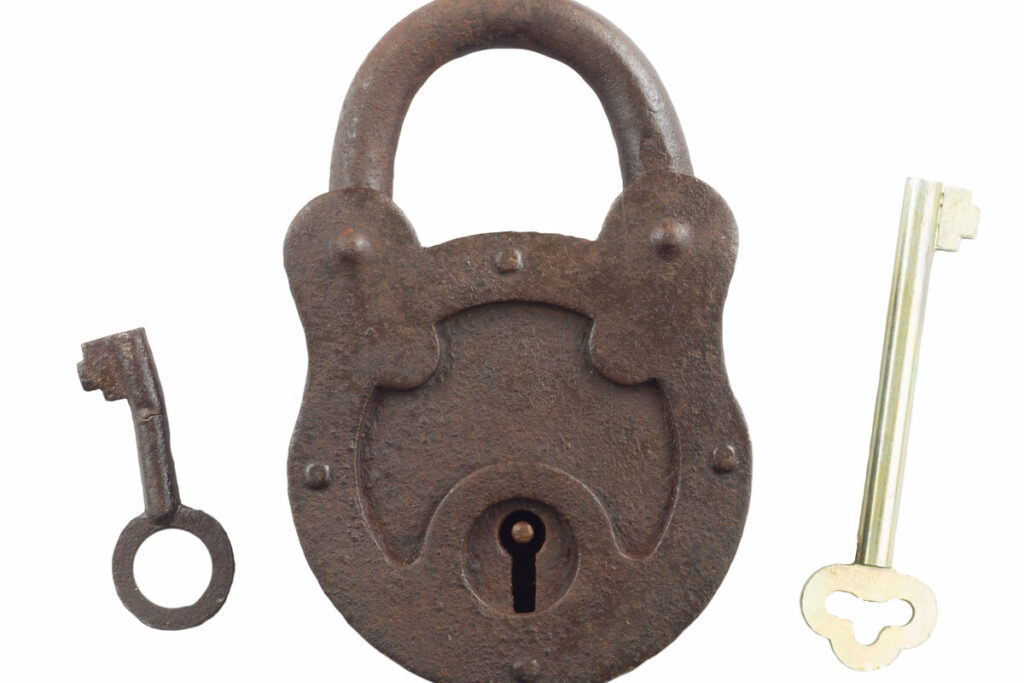
The lock nobody has managed to pick
The twist rests on a strange imbalance. Mathematicians know fast ways to test whether a number is prime. But take a huge number built by multiplying primes together, and try to break it back into those primes: there is no known fast method.
It is not for lack of trying. Despite enormous theoretical and practical effort, no truly fast factoring algorithm has ever been found. That stubborn gap, between easy multiplication and hard factoring, is part of what keeps data protected.
Useless today, essential tomorrow
Number theory kept growing long before anyone found a use for it. Dirichlet’s theorem on arithmetic progressions in 1837 is the conventional starting point of analytic number theory, and Bernhard Riemann’s 1859 work on the zeta function brought complex analysis into the study of whole numbers.
None of it was done with security in mind. Dickson’s boast is a reminder that the most abstract question in mathematics today might quietly become the lock on tomorrow’s front door.