Long before Leonardo da Vinci sketched his famous man inside a circle, a medieval nun named Hildegard of Bingen described almost the same image in a mystical vision. That shared picture is one thread in a much older idea: that the shape of the universe itself might be geometric.
A vision of a man stretched inside a sphere
Hildegard of Bingen wrote about a figure she called the “Microcosmic Man”: a human body stretched out at the exact center of a circular orb.
The theologians of her time read the image as a map of everything. At the center stood Christ and, with him, all of humanity. The circumference around the figure represented the entire universe.
Much later, Leonardo da Vinci (1452-1519), artist and scientist, was inspired by her visions when he created his Vitruvian Man. One of the most reproduced drawings in the world has roots in a religious diagram of the cosmos.
The old belief that God works like a geometer
The idea behind that picture goes back to ancient Greece. Plato is the central figure linked to the belief that the divine built the universe according to a strict geometric plan. Plutarch attributed to him a short and striking line: “God geometrizes continually.”
This is what people mean by sacred geometry. Certain shapes and proportions are given a symbolic, even spiritual meaning, because they are thought to reflect the design of a divine creator.
The belief was not limited to philosophers. In the early Middle Ages, Christian thinkers explained the universe through the analogy of the microcosm, the idea that a human being mirrors the whole cosmos in miniature. Hildegard developed this idea in her own writings.
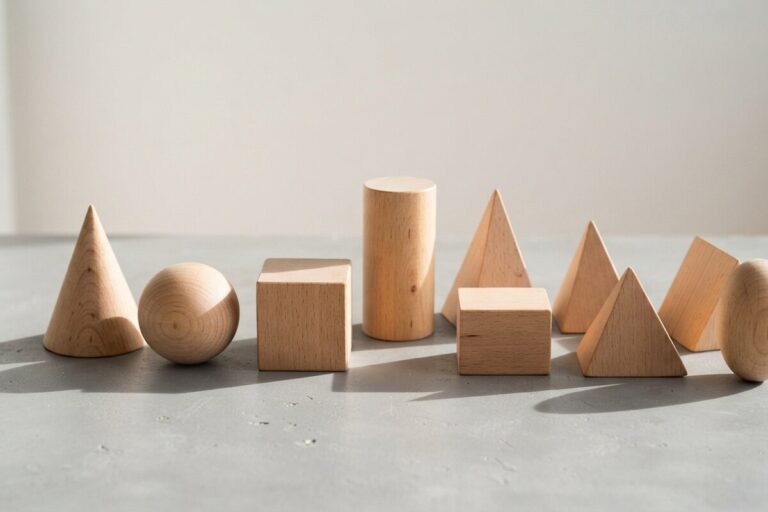
Even an astronomer took it seriously. In 1596, Johannes Kepler published Mysterium Cosmographicum, a bold model in which the Platonic solids were supposed to explain the spacing of the planets. He believed deeply that the cosmos rested on sacred geometric foundations.
Circles, squares and a palace at the center of the world
Once you know the idea, you start seeing it in buildings across very different cultures.
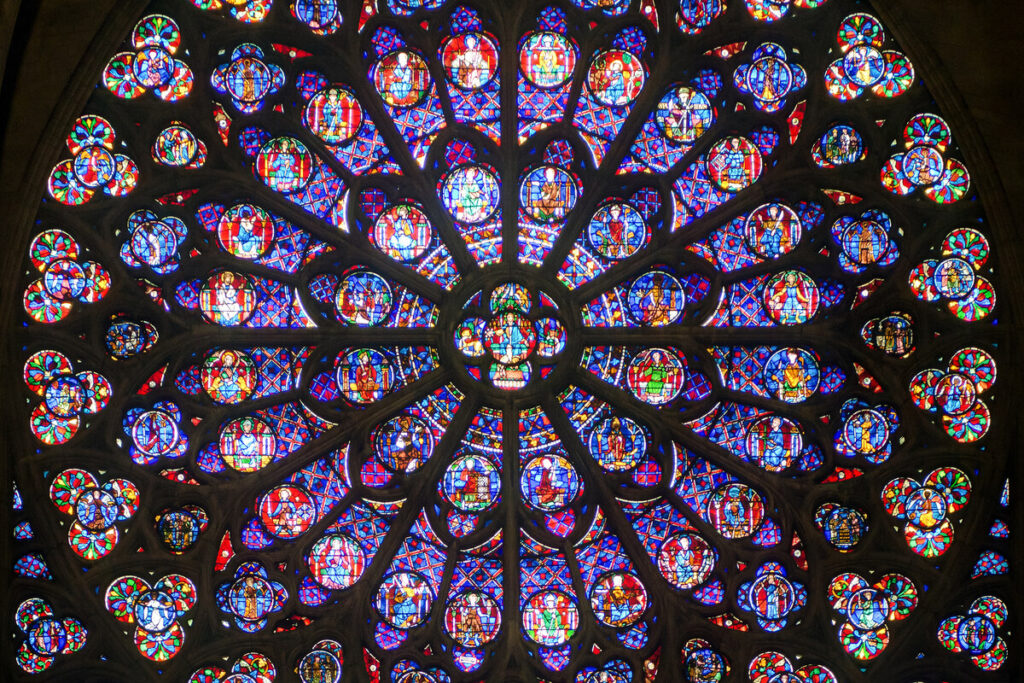
Medieval European cathedrals relied on precise geometry, meant to bring worshippers closer to the divine through mathematics itself. At the start of the Renaissance, church architecture shifted toward simpler, more regular shapes, and the circle became central.
In literature, Dante built the cosmology of his Divine Comedy out of concentric circles, stretching symbolically from Jerusalem all the way up to God in the highest heaven. The structure was directly inspired by the ancient astronomer Ptolemy.
In China, the Forbidden City is laid out as a rectangle more than half a mile long. The Hall of Supreme Harmony, home of the imperial throne, sits exactly at the center of the main axis. The geometry turned the Emperor, quite literally, into the center of the universe.
Hindu temples follow the principles of Vastu Shastra, in which the parts of a building deliberately repeat the structure of the whole. It is a design logic surprisingly close to what mathematicians now call fractals. Traditional Chinese feng shui, for its part, uses geometric principles to balance people and their surroundings.
The sand mandala built to be destroyed
Buddhist mandalas combine concentric circles and squares to represent different deities. Tibetan monks create them in colored sand, following a carefully calculated grid set out in advance.
Then, once the ceremony is over, they take the whole thing apart on purpose. The ritual destruction is the point: a perfectly planned geometric work, undone to celebrate the impermanence of all things.
Where sacred geometry stops being convincing
None of this means every old temple hides a secret mathematical code. That is the most common trap in the subject.
A popular habit consists of drawing a geometric diagram over a photo of a building, a plant or a painting, then declaring it proof of sacred design. The researcher Stephen Skinner criticizes this as “ungrounded geometry”: if the lines do not line up precisely with the major physical points of the image, the whole analysis has no real foundation.
History also calls for some modesty. Geometry was only “sometimes considered sacred”, which suggests it was applied unevenly, depending on the era and the tradition. Not every religious building was consciously designed around a hidden plan.
What these shapes really tell us
The most interesting part of sacred geometry may not be any secret number. It is the fact that so many cultures, separated by oceans and centuries, reached for the same simple tools, the circle, the square and the center point, when they wanted to describe their place in the universe.
A nun’s vision, a Chinese palace and a grid of sand all say the same thing in different languages. Long before modern science, people already suspected that the world might be written in shapes.