Most of us learned symmetry as a folding trick: draw a line down the middle and check that both halves match. But mathematicians, artists and physicists have stretched that simple idea much further, from bronze vessels cast in ancient China to the deepest laws of nature.
In mathematics, symmetry means that an object stays unchanged when you apply a specific transformation to it. That transformation can be a reflection, a rotation, a slide (called a translation) or even a change of scale. Once you see symmetry that way, it starts turning up in surprising places. Here are five of them.
1. Your brain is tuned to one kind of symmetry above all others
Not every symmetry hits us with the same force. In 1897, the philosopher and physicist Ernst Mach noted in his book The Analysis of Sensations that mirror symmetry around a vertical line stands out far more to the human eye than other kinds.
The most familiar example is the human face. A left half that mirrors a right half is something we pick up almost instantly, while other types of symmetry, like a pattern that repeats as it rotates, are much less immediately obvious to an observer.
That sensitivity fits our own bodies. Humans belong to the bilateral animals, whose bodies are symmetric across a single plane that splits them into a left half and a right half.
2. Perfect symmetry is not the crowd pleaser you might expect
It is tempting to think that the more symmetric something is, the more beautiful it looks. The reality is more subtle. People do tend to find bilateral symmetry attractive overall, but too much symmetry is actually perceived as boring. We generally prefer some complexity, as long as it still feels balanced.
Modern architecture took that lesson to heart. One architecture critic went as far as saying that only a bad architect relies on a purely symmetrical layout. Modernist buildings usually aim for a simple balance of masses rather than a strict, rigid mirror image.
3. Chinese bronze casters mixed two symmetries thousands of years ago
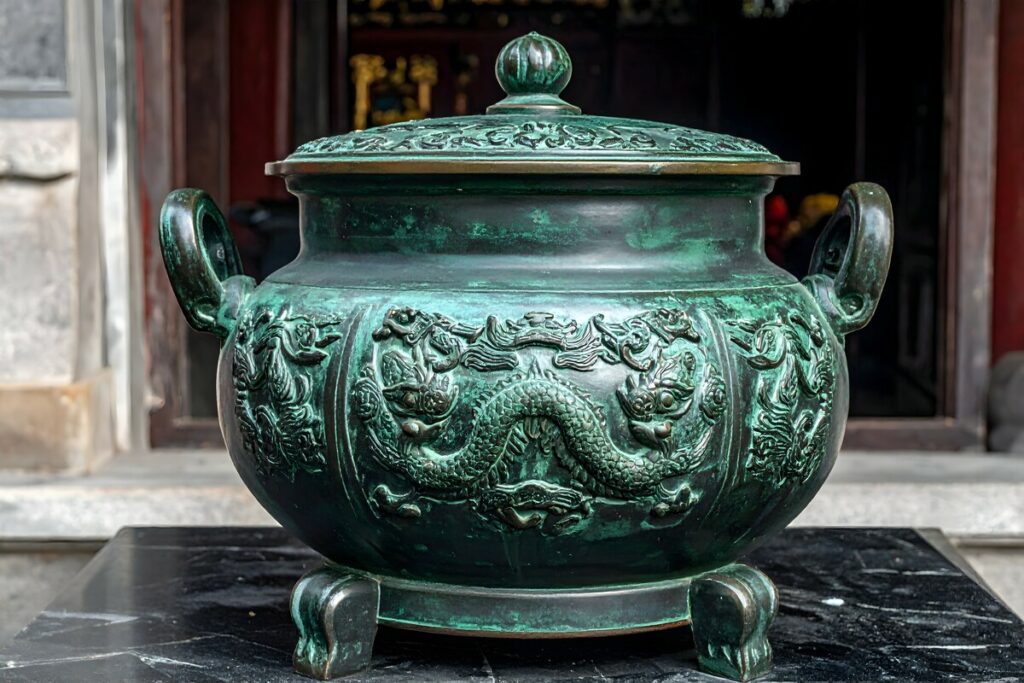
Symmetry as a design tool is ancient. Craftsmen in China were already casting bronze with elaborate symmetric patterns as early as the 17th century BC.
What makes their work striking is that they combined two different kinds at once: a main motif with left and right sides mirroring each other, framed by a border made by sliding one small pattern along again and again. In modern terms, that is reflection and translation working together on the same object.
Traditional Persian rugs belong to the same long tradition. Their centers and borders are mirrored in intricate ways, yet the whole design grows out of one single basic motif.
4. Potters get symmetry for free, then deliberately break it
Ceramics has had a particularly close relationship with symmetry ever since the first potter’s wheels. Anything shaped on a spinning wheel naturally ends up with full rotational symmetry in cross section: turn the bowl around its center and its outline does not change.
The interesting part is what artisans did next. They often added decorations that intentionally broke that perfect symmetry, for purely aesthetic reasons. It is the same instinct as in fact number two: flawless regularity alone rarely satisfies the eye.
5. A composer and a Nobel physicist both built their work on it
Symmetry is not only visual. In 1910, the composer Alban Berg wrote his Quartet, Op. 3, probably the first large scale piece of music based systematically on symmetric relationships between pitches. Berg kept returning to axes of symmetry and cycles of intervals in his non tonal music.
Physics pushed the idea even further. Physicists generalized symmetry to mean staying unchanged under any kind of transformation, including arbitrary changes of coordinates. In his famous 1972 essay “More is Different”, the Nobel laureate P. W. Anderson summed it up bluntly: “physics is the study of symmetry”. For him, practically all the fundamental laws of nature flow directly from symmetry principles.
From a folded sheet of paper to the laws of nature
The same idea also hides in shapes that seem chaotic. Fractals, for instance, carry a kind of scale symmetry, where the smallest parts of the figure look like the largest ones, and helical symmetry combines a rotation and a slide along the same axis.
So the next time you fold a paper heart to check that both sides match, remember that you are using a tool that runs from ancient bronze workshops to modern physics. Symmetry is less a property of pretty shapes than a way of asking one powerful question: what can change without anything really changing?