In 2023, mathematicians finally solved a problem that had resisted every attempt for more than 60 years: they found a single shape that can tile a surface forever without the pattern ever repeating.
That discovery, nicknamed the “hat” tile, closed out a search that had frustrated some of the sharpest minds in geometry. It also turns out to be just the latest chapter in a much longer story. Here are 5 facts about tiling patterns that took mathematicians centuries, and sometimes millennia, to work out.
Only three regular shapes can tile a plane by themselves
A tessellation is a surface covered completely by repeating shapes, with no gaps and no overlaps. It sounds like something almost any shape should be able to do.
It isn’t. Among all the regular polygons, only three (the equilateral triangle, the square, and the regular hexagon) can tile a flat plane entirely on their own, edge to edge, with nothing left over.
People noticed this long before anyone proved it. Sumerian builders were tiling walls with clay pieces as early as 4000 BCE. It took until 1619 for Johannes Kepler to catalog these patterns systematically in his book Harmonices Mundi.
Bees solved a geometry problem before anyone had defined it
Long before Kepler picked up a pen, bees had already settled on the hexagon. A honeycomb is a nearly perfect hexagonal tiling, and that shape isn’t an accident.
The hexagon happens to be the most efficient way to divide a surface into equal cells while using the least amount of material for the walls. Bees arrived at that solution through instinct and evolution, generations before any mathematician sat down to formalize why it works.
It took one mathematician to prove two shapes were enough to break the pattern
For a long time, tiling meant repetition. A pattern that never repeated seemed like it would need dozens of different shapes, if it was even possible at all.
Roger Penrose showed otherwise. He built tilings, now known as Penrose tilings, using only two quadrilateral shapes, arranged in a way that never forms a repeating pattern no matter how far it extends.
Even more surprising, these non-repeating patterns aren’t formless. They still contain their own local symmetries, small pockets of rotation and reflection, even though the overall design never loops back on itself.
A physicist’s 19th-century guess stood unbeaten for over a century
Tiling isn’t limited to flat surfaces. In three dimensions, the question becomes how to fill space itself as efficiently as possible.
In 1887, Lord Kelvin proposed a solution: a single repeating shape called a truncated octahedron, designed to divide space into equal-volume cells using the least possible surface area.
Nobody beat it for more than 100 years. It wasn’t until 1993 that Denis Weaire and Robert Phelan discovered a structure that used less surface area than Kelvin’s, finally improving on a guess that had gone unchallenged since the 19th century.
Mathematicians just found the shape that ends a decades-long hunt
Mathematicians had long suspected that a single shape could tile a surface forever without ever repeating, a puzzle known as the “Einstein problem” (from the German “ein stein,” meaning one stone, not the physicist).
In 2022 and 2023, David Smith and his collaborators found and proved it: a 13-sided shape now called the “hat” tile. It covers a surface completely, edge to edge, and never falls into a repeating pattern, no matter how large the surface grows.
It’s worth noting how much is still unknown here. There is still no general rule for predicting whether any given shape can tile a plane at all. Plenty of related questions remain wide open even after this breakthrough.
A palace in Spain and an infinite spiral
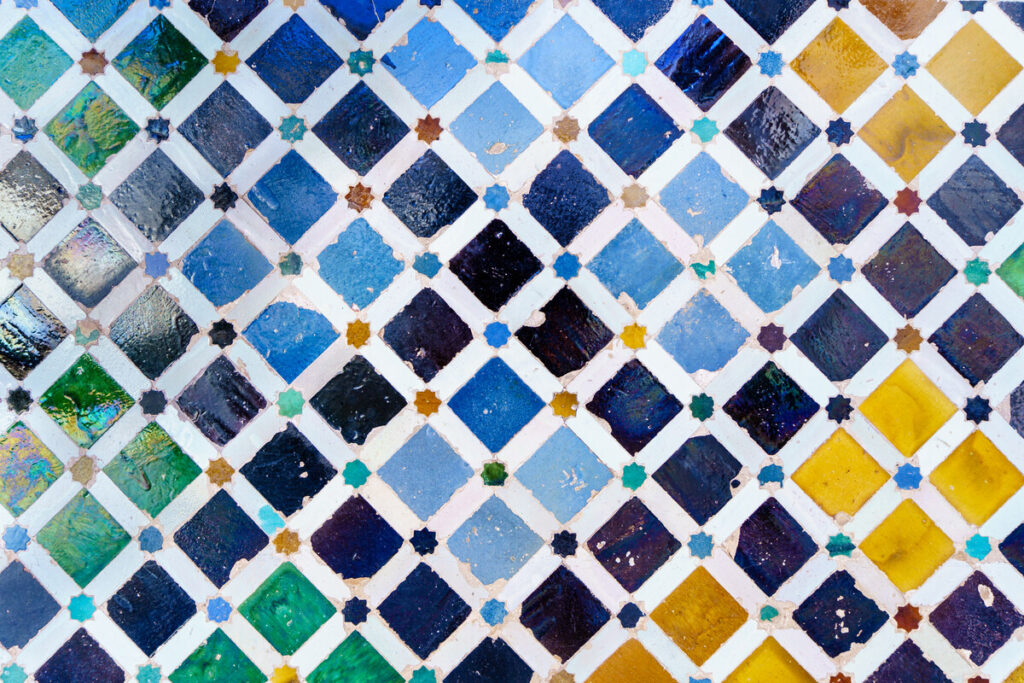
Tiling didn’t stay confined to mathematics and beehives. In 1936, the artist M. C. Escher visited the Alhambra in Spain and studied its Moorish mosaics up close.
That visit changed the direction of his entire career. Escher went on to build tessellations using both flat and hyperbolic geometry, including a series called Circle Limit, where interlocking figures spiral toward the edge of a circle without ever quite reaching it.
From clay tiles in ancient Sumer to a shape discovered in 2023, tiling keeps turning out to be one of those ideas that looks simple on the surface and keeps rewarding anyone who looks closer.