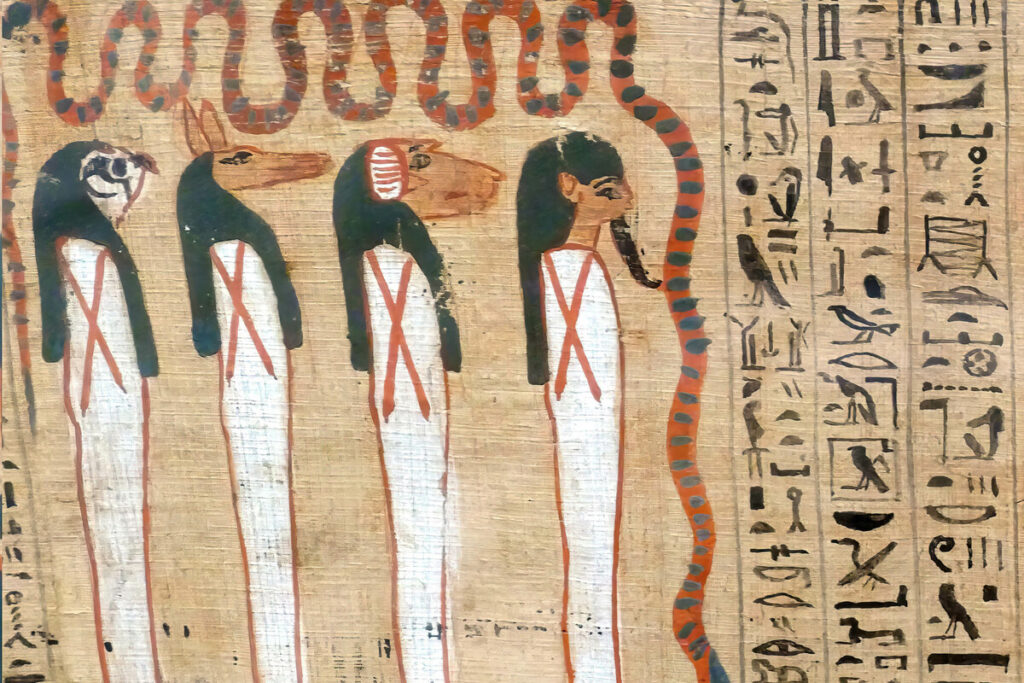
Three thousand six hundred years ago, an Egyptian scribe wrote down 84 math problems, and every single answer had to follow one strict rule that modern fractions completely ignore.
The rule you learned in school is younger than you think
A fraction is just a broken piece of a whole. The word itself comes from the Latin fractus, literally “broken.” A numerator on top counts the parts you have, a denominator on the bottom counts how many equal parts make up the whole.
That much feels ancient and obvious. But the split between “proper” fractions (smaller than one) and “improper” fractions (equal to or bigger than one) is surprisingly recent. The 17th century arithmetic manual The Ground of Arts already explained improper fractions as if the idea needed introducing, centuries after fractions themselves were common knowledge.
The eye of Horus myth
A popular story claims ancient Egyptian fraction hieroglyphs were secretly coded into the different parts of the eye of Horus, a sacred symbol split into mystical mathematical segments.
Researchers have largely discredited this idea. The so called Horus-eye fractions were simply successive powers of one half, a practical shorthand with no real symbolic link to the eye’s anatomy at all.
What Egyptians actually did instead
The real system was stranger and stricter. Except for one half, two thirds, and three quarters (which each got their own hieroglyph), every Egyptian fraction had to be written as a sum of unit fractions, each with a numerator of exactly one, and no denominator could repeat.
The scribe Ahmes wrote all 84 problems of the famous Rhind Papyrus using exactly this method. Centuries later, the Greek astronomer Ptolemy openly complained that the Egyptian system was clumsy compared to the Babylonian alternative he preferred.
Even Fibonacci got tangled up in it
The rule stuck around far longer than most people assume. Leonardo of Pisa, better known as Fibonacci, documented these unit fraction conversions in his 1202 book Liber Abaci, centuries after the pharaohs.
Fibonacci even admitted his own shortcut method, now called the greedy algorithm, could misfire badly. Converting 5/121 his way produces denominators larger than a quadrillion, when a far simpler answer (1/33 plus 1/121 plus 1/363) does the exact same job.
Not everything that looks like a fraction is one
Fraction notation got so familiar that it started showing up where it does not belong. Old British pre-decimal money used a notation like “3/6” that looked exactly like a fraction of three sixths.
It actually meant three shillings and six pence, with no mathematical relationship to a fraction whatsoever. The stacked notation was just a convenient way to write two numbers close together, borrowed straight from math without borrowing the math itself.
The trick still settles arguments today
Splitting 5 whole pizzas evenly among 8 people works out to 5/8 each. Written as unit fractions, that is one half plus one eighth, meaning 4 pizzas get cut into halves and the last one into eighths. Nobody ends up with a mathematically ugly slice.
A rule built for scribes carving symbols into papyrus three and a half millennia ago still quietly settles a fair split at the dinner table. Numbers rarely stay confined to the century that invented them.