

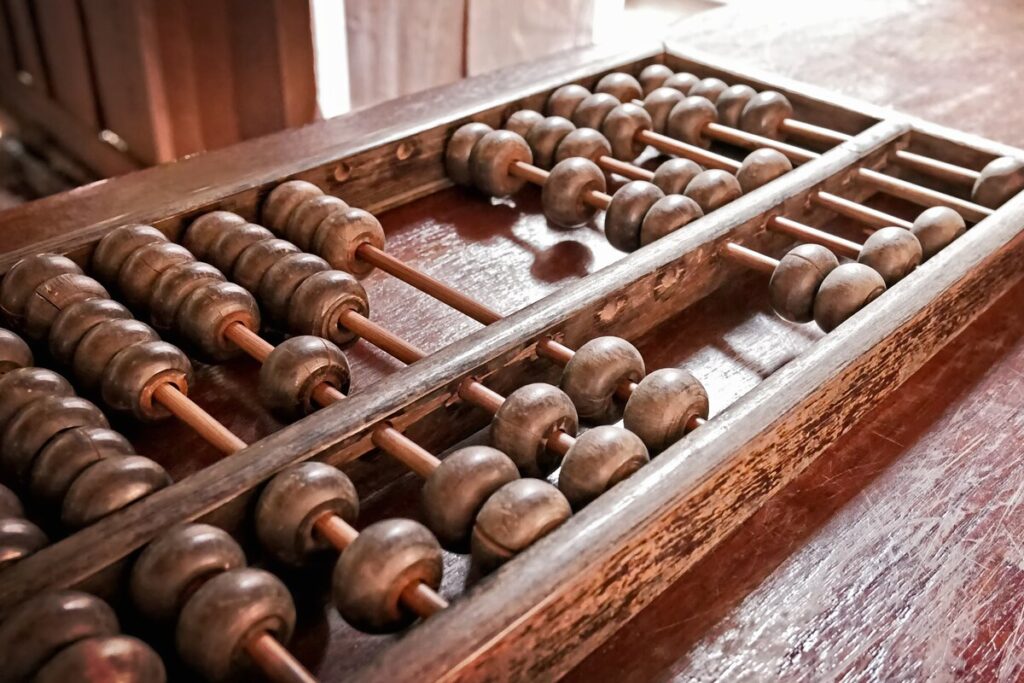
A skilled abacus operator once beat a modern calculator salesman in a live speed contest, and that upset is just the start of this ancient tool’s strange history. Long before silicon chips, sliding beads solved real math problems, and some of the results still hold up today.
The oldest known calculator is a slab of marble
The earliest counting device on record isn’t made of wood or metal. It’s the Salamis Tablet, a 149-centimeter slab of white marble dating back to around 300 BC.
Discovered in 1846 on the Greek island of Salamis, it predates every wooden counting frame most people picture when they hear the word “abacus.” Historians consider it the oldest surviving calculating tool in the world, centuries before the Roman grooved counting boards that came after it.
A calculator salesman lost to a man with beads
According to science writer Yakov Perelman, some businessmen tried to bring mechanical calculators into Russia in the early 20th century. They gave up after watching an experienced abacus operator work.
The speed was simply too much to compete with. For everyday arithmetic, a trained hand on a Russian schoty could outpace a machine built specifically to replace it.
That schoty even had a dedicated column of just four beads, built to track quarters of a ruble, a detail that only made sense because of Russia’s currency system before 1916.
An Aztec abacus matched the seasons on purpose
The Aztec counting tool, called the nepohualtzintzin, used exactly 91 beads. That number wasn’t random.
It lined up with the 91-day seasons, the 182-day maize growing cycle, and came close to the 364-day count some Aztec calendars used for a full year. The device wasn’t just for arithmetic, it quietly tracked time too.
A tool most people would assume was purely practical turns out to double as a compact calendar, built centuries before anyone had a name for either discipline.
One abacus was rebuilt for people who can’t see it
Not every version of this tool relies on sight. Tim Cranmer designed an abacus specifically for blind users, using a special cloth backing that keeps the beads firmly in place under a finger.
It let users calculate by touch alone, with no risk of beads sliding out of position between operations, something no touchscreen calculator can promise.
IBM built one so small it needed nanotechnology
In 1997, IBM engineers built the first nano-abacus, shrinking the ancient design down to a scale that required nanotechnology to construct at all.
A tool invented for merchants and scribes ended up as a demonstration of some of the most advanced engineering of the late 20th century, proof the same basic idea still had something to teach modern science.
Still counting, thousands of years later
Electronic calculators never fully replaced this tool. It’s still used daily in parts of Russia, China, Africa, and Eastern Europe, and children trained on it tend to get noticeably better at mental math, with measurable effects on how their brains process numbers.
A device this old shouldn’t still be relevant. And yet, one slide of a bead at a time, it is.