During the Second World War, Allied intelligence estimated that Germany was building about 1,400 tanks a month, while a handful of statisticians armed with serial numbers said 246.
After the war, the records of Albert Speer’s armaments ministry settled the argument. The real figure was 245.
A rumor nobody could ignore
Allied commanders had already met the new Panzer V, better known as the Panther, in Italy. They expected it to show up in northern France only in small numbers, much like the Tiger I had in Tunisia.
The US Army felt confident. Its Sherman had performed well against the Panzer III and Panzer IV in North Africa and Sicily. A November 1943 policy statement even declared: “The M4 tank has been hailed widely as the best tank of the battlefield today.”
Then, shortly before D-Day, rumors began to spread. Large numbers of Panthers were said to be in service. How many, exactly? Nobody really knew.
Guesswork versus serial numbers
Conventional intelligence had a habit of overestimating Nazi output. Its numbers kept landing far too high.
Statisticians took a completely different route. German factories stamped serial numbers on tank parts, and those numbers followed an order. Gearboxes were the main source, because they ran in two unbroken sequences. Chassis and engines were used too, though they were harder to analyze.
Every captured or destroyed tank became a data point. Without knowing it, the enemy was publishing its own production figures.
The surprisingly simple trick behind the estimate
Imagine you capture four tanks with serial numbers 19, 40, 42 and 60. How many tanks exist in total?
The naive answer is 60, the biggest number you have seen. But that answer almost always falls short, because you are very unlikely to have captured the very last tank off the line.
The fix is elegant. Take the largest serial number, then add the average gap between the numbers you observed, minus one small correction. Here, that gives an estimate of about 74 tanks.
The more tanks you sample, the less you need to add. With a single tank, the best guess is double its serial number. With five, it is roughly 20 percent above the highest one. With twenty, only about 5 percent above.
The scoreboard after the war
Once German records became available, the comparison was brutal for traditional intelligence. These figures come from a 1947 analysis by Ruggles and Brodie:
- June 1940: intelligence said 1,000 tanks, statistics said 169, the real number was 122
- June 1941: intelligence said 1,550, statistics said 244, the real number was 271
- August 1942: intelligence said 1,550, statistics said 327, the real number was 342
Intelligence overshot by a factor of four to eight. The statisticians were never off by more than a few dozen tanks.
Even the wheels were talking
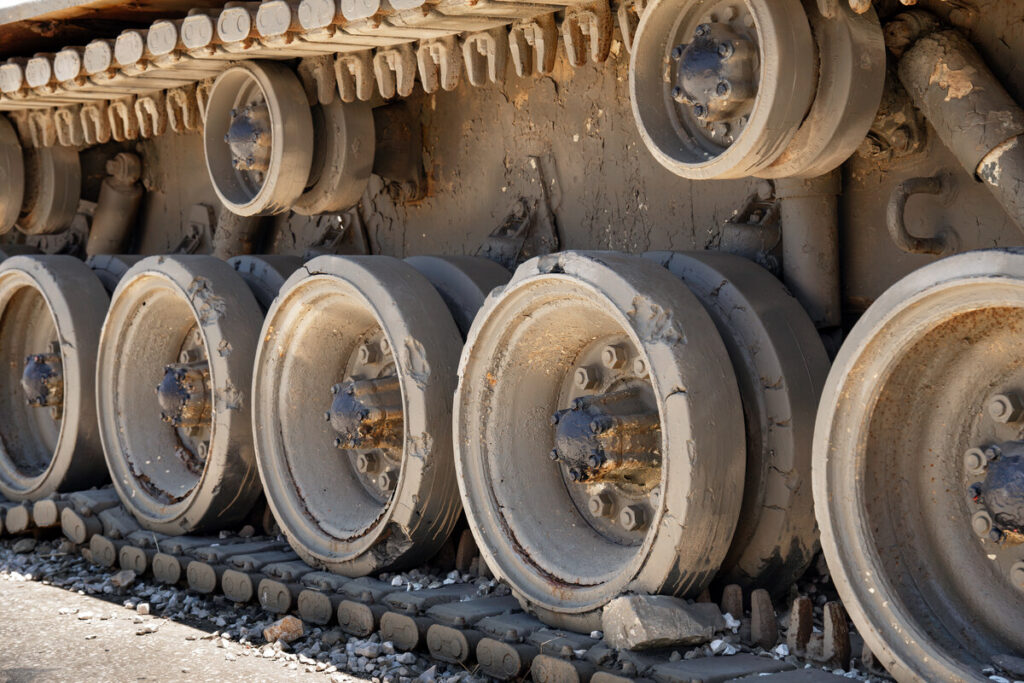
One analysis went further still. Road wheels were also numbered in sequence, and studying them revealed how many wheel moulds were in use. British wheel manufacturers then helped work out how many wheels those moulds could turn out, and therefore how many tanks.
The wheels of just two tanks, 64 in all, pointed to 270 tanks produced in February 1944, far more than anyone had suspected. German records later gave the true figure: 276.
The same numbers revealed even more: how many factories existed, which ones mattered most, how long the supply chain was, and how much rubber the war machine was using.
A trick that never retired
V-2 rocket production was estimated with great success using the same approach. Soviet equipment markings were analyzed during the Korean War. In the 1980s, production numbers of Israeli Merkava tanks were classified, but their serial numbers gave the game away.
It even works on home computers. Applied to the Commodore 64, the formula gives around 12.5 million units, in line with the low-end estimates.
The lesson for anyone keeping secrets is clear: sequential numbering leaks information. The real fix is to use random serial numbers drawn from a much larger range, a choice where the birthday problem suddenly matters. Scrambling the digits with a simple code is not enough, because the hidden sequence still leaves a pattern.
Like Abraham Wald and his bullet-riddled planes (one of our famous cases of survivorship bias), the German tank problem shows that wars are not only fought with steel. Sometimes the sharpest weapon is a statistician who knows what a few overlooked numbers are really saying.