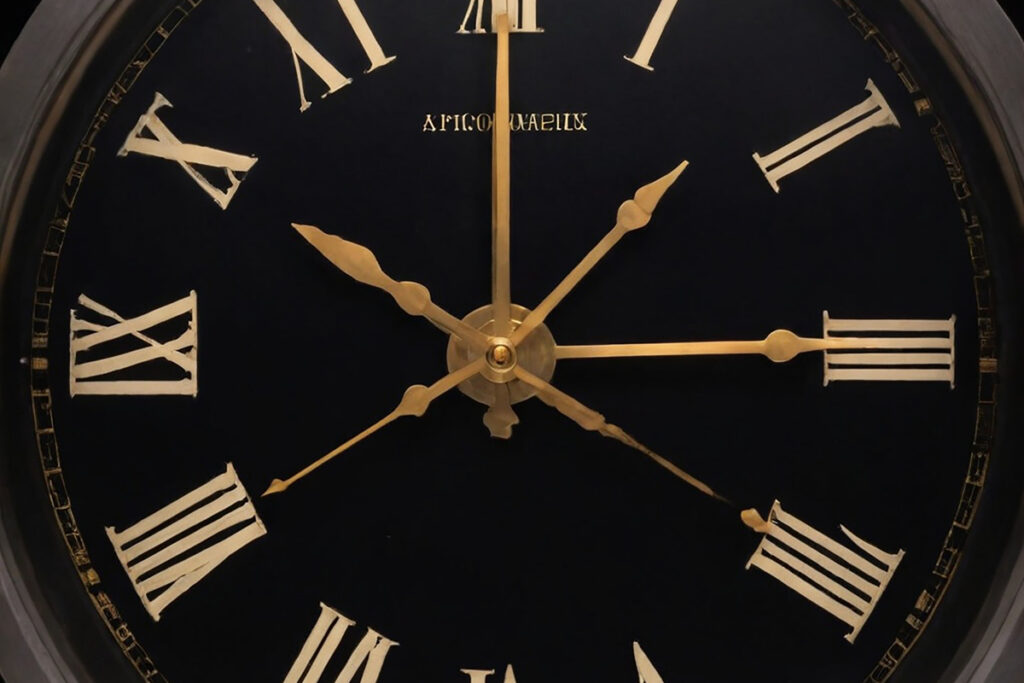
Look up at almost any clock with roman numerals on its face, and the number 4 reads IIII, not IV. It is not a printing mistake. It has never been one.
A rule that was never really a rule
School teaches roman numerals as a fixed system: I, V, X, L, C, D and M, combined with a subtractive trick where a smaller symbol placed before a bigger one gets subtracted instead of added. That is how IV becomes 4 and IX becomes 9.
But that subtractive shortcut only ever applied to a handful of specific pairs: IV, IX, XL, XC, CD and CM. For every other number, Romans simply repeated symbols, the same way VI, VII and VIII stack an extra I, II or III onto V.
Roman scribes and engravers did not always bother applying the subtractive shortcut even where it existed. On the numbered entrances of the Colosseum in Rome, the number 4 is carved as IIII, plain repetition, no subtraction at all. Gate number 44 reads XLIIII, mixing both styles in a single number.
The Jupiter myth that refuses to die
One popular explanation claims Romans avoided writing IV on purpose, out of religious respect for the god Jupiter, since his Latin name IVPITER happens to start with those same two letters.
It is a great story. It is also almost certainly invented. Writer Isaac Asimov, who repeated the theory himself, described it only as an “interesting theory” and never traced it to any serious historical source. In other words, it sounds convincing mostly because it sounds convincing.
Clocks kept the old habit alive on purpose
Modern roman numeral clocks almost universally still use IIII for 4, while switching to IX for 9. That is not an accident either. It is a tradition that survived from medieval clockmaking, including the famous Wells Cathedral clock from the late 14th century.
Clockmakers likely favored IIII for balance and legibility: four identical strokes sit visually opposite VIII, keeping the dial symmetrical in a way that IV would not.
Buildings and ships prove it goes beyond clocks
London’s Admiralty Arch carries the year 1910 carved as MDCCCCX, a much older and more elaborate style than the shorter MCMX most people would expect. It was a deliberate choice, meant to give the inscription a heavier, more solemn look.
On the Cutty Sark, the historic sailing ship still docked in Greenwich, roman numerals mark the vessel’s draft along the hull, running from 13 up to 22 from bottom to top. No subtractive elegance required there either, just a practical, readable sequence.
A system that never fully disappeared
Roman numerals were gradually replaced by Hindu-Arabic digits across Europe by the 14th century, mostly because they made arithmetic far easier to perform on paper. But they never actually vanished.
They still show up on monarchs’ names, monument inscriptions, movie credits and plenty of clock faces that quietly keep breaking the “rule” generations of students were taught was absolute. Sometimes the version of history that survives is not the most logical one. It is simply the one that looked best on the wall.
The next time a clock or a monument shows a number that does not match the rule from a math textbook, it is worth remembering that roman numerals were never a single rigid code handed down from Rome. They were a set of habits, adjusted over centuries by scribes, engravers and clockmakers who each chose balance, tradition or visual effect over strict consistency.