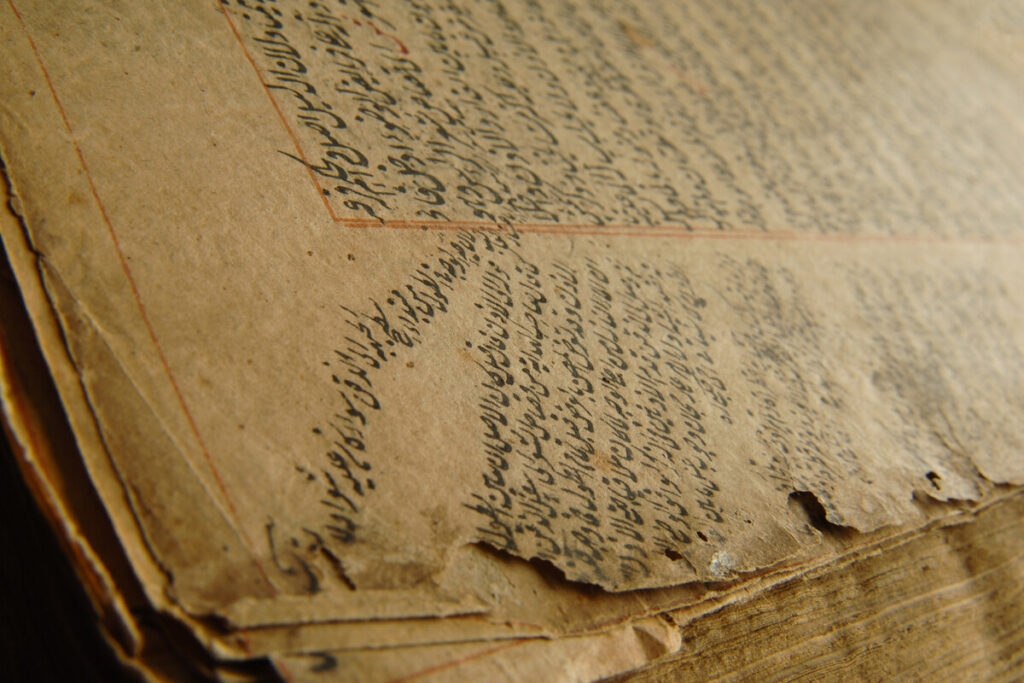
Algebra did not arrive fully formed. It spent centuries changing shape so completely that its earliest versions barely look like math at all.
The word algebra itself comes from al-jabr, a term drawn straight from a 9th century treatise by the Persian mathematician al-Khwarizmi. But the ideas behind it stretch back much further, through three distinct stages that transformed how equations were written and solved.
Three disguises: rhetorical, syncopated, symbolic
Historians describe algebra as passing through three stages. Rhetorical algebra wrote equations out as full sentences, with no symbols at all. Syncopated algebra introduced abbreviations for certain terms. Symbolic algebra, the version taught in schools today, uses complete mathematical notation.
The Babylonians worked entirely in the rhetorical stage, yet they still solved quadratic and even cubic equations using a positional number system, showing far more sophistication than their lack of notation might suggest. The Egyptian Rhind Papyrus, from around 1650 BCE, called its unknown quantity aha or heap, and its author checked every solution carefully, effectively writing one of the earliest simple mathematical proofs in history.
The myth that the Greeks had no algebra
It is tempting to assume the ancient Greeks, famous for their geometry, had no algebra at all. In reality they developed what historians call geometric algebra, representing quantities as the sides of shapes and solving equations through a method called application of areas. Their mathematics simply looked different, not absent.
The syncopated stage arrived with Diophantus of Alexandria in the 3rd century CE, who became the first mathematician to use symbols for unknown numbers and shorthand for powers, writing his ideas down in his work known as the Arithmetica.
A Persian scholar’s balancing act, and a word with two meanings
Al-Khwarizmi’s 830 treatise introduced the twin concepts of reduction and balancing, moving subtracted terms from one side of an equation to the other. He worked exclusively with positive roots and did not even recognize zero as a valid solution, a reminder of how far the concept of an equation still had to evolve.
In medieval Spain, the word algebrista carried a second meaning entirely unrelated to mathematics: a bone setter, someone who realigned broken bones. It is a direct echo of the original Arabic sense of al-jabr, which literally means the reunion of broken parts.
From geometric solutions to full symbolism
The Persian mathematician Omar Khayyam pushed algebra further in the 11th century, tackling cubic equations and providing geometric solutions for the general case. Centuries later, the French mathematician Sharaf al-Din al-Tusi identified how to find the maximum and minimum points of curves in order to solve cubic equations, an early method that anticipated calculus by hundreds of years before Newton and Leibniz.
Full symbolic algebra only arrived in the 16th century, when Francois Viete introduced variables to represent unknown or indeterminate numbers. Rene Descartes then supplied the modern notation still in use, including the letter x, and showed that geometric problems could be translated directly into algebra, founding what we now call Cartesian geometry.
Even the origins of Arabic algebra remain debated, with historians pointing to possible Hindu, Mesopotamian and Greek influences, most agreeing it likely drew on all three at once. A subject most people assume has always looked the same actually spent thousands of years changing costume before settling into the equations taught today.