

In 1822, someone painted a chain of six touching spheres on a wooden tablet and hung it in a shrine in Kanagawa, 115 years before Frederick Soddy published the same discovery in the West.
Math as an offering to the gods
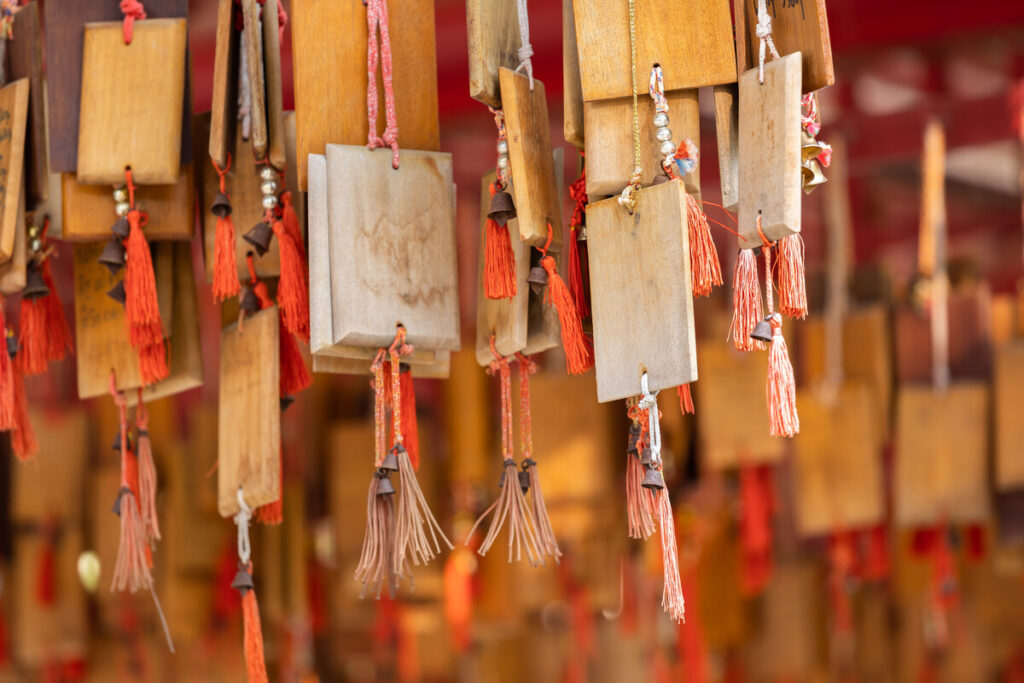
Those tablets are called sangaku, “calculation tablets” in Japanese. During the Edo period, people from every social class painted geometry problems and theorems in color on wooden boards and hung them at Shinto shrines and Buddhist temples.
Some were offerings to the kami and buddhas. Others were open challenges to anyone who walked by, or proud displays of a solved problem. About nine hundred tablets survive today, though many were lost when Japan modernized after the Edo period.
A country doing math on its own
This happened while Japan kept strict rules on trade and contact with Western countries. Its mathematicians built their own tools in parallel with Europe, and the paths were not the same.
The link between an integral and a derivative, the heart of Western calculus, was unknown to them. So problems about areas and volumes were attacked with infinite series, worked out one term at a time.
In 1790, the prominent mathematician Fujita Kagen published the first collection of these puzzles under the title Shimpeki Sampo, “Mathematical problems suspended from the temple”. A sequel followed in 1806.
Three circles and one missing size
A typical tablet, from 1824 in Gunma Prefecture, shows three circles touching each other and a common straight line. You know the size of the two big outer circles. What is the size of the small one squeezed between them?
The answer turns out to be a tidy relationship between the three sizes. It is a special case of what Westerners know as Descartes’ theorem, and here it sat on a temple wall, painted by someone for the love of the puzzle.
The six spheres that Europe “discovered” in 1937
Now picture three spheres that all touch one another. Fit a ring of six more spheres around them, each touching its two neighbors and the original three. That structure is called Soddy’s hexlet.
Frederick Soddy rediscovered it independently in a 1937 paper and proved that a hexlet always exists, whatever three touching spheres you start with. The ring can even be rotated and rescaled in endless ways, and the centers of its six spheres always sit in one flat plane, on a conic section.
For decades it was credited as a Western find. Then it turned up on that sangaku from 1822.
The genius behind the scene
Behind this tradition stands Seki Takakazu, a samurai and feudal officer sometimes described as “Japan’s Newton”. He created a new algebraic notation and worked on infinite series and infinitesimals. He is credited with the resultant and the determinant, with Bernoulli numbers, and with pi to ten decimal places.
How much of it was truly his is unclear, because many results appear only in the writings of his pupils.
Puzzles that are still not finished
These boards are not just museum pieces. One problem from Sawa Masayoshi and another from Jihei Morikawa were solved only recently, long after they were painted.
It is a humbling thought for any math class. Somewhere, a ring of spheres hung on a wall for 115 years before anyone in the West wrote it down.