
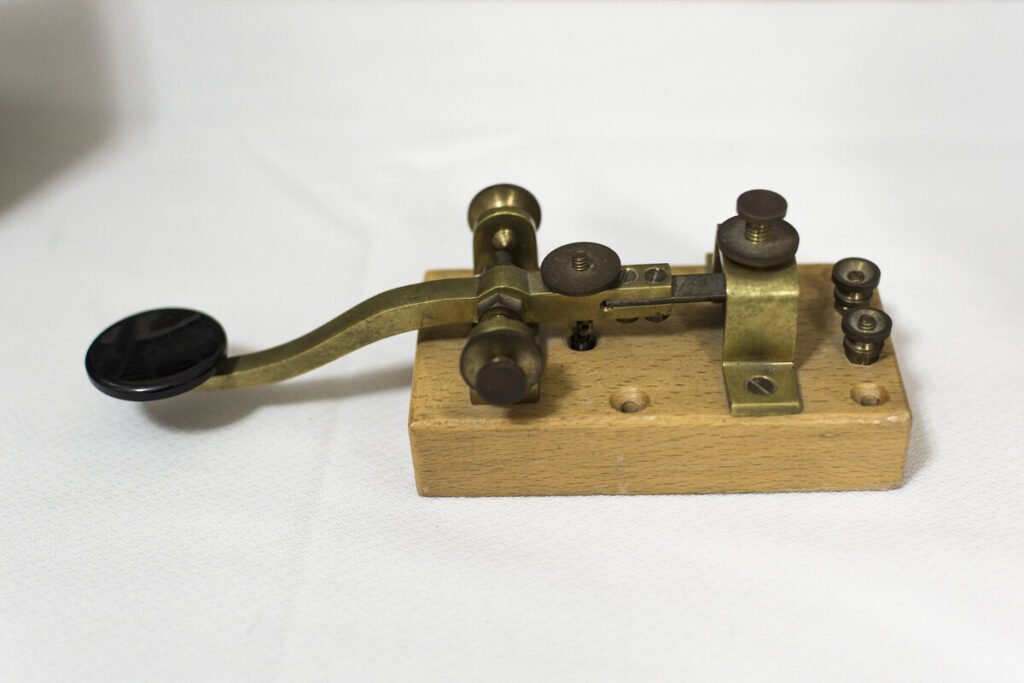
In 1873, a young telegraph operator applied to join a society of engineers and was told that “they didn’t want telegraph clerks”. He went on to rewrite the laws of electricity and magnetism.
A school leaver with a famous uncle
Oliver Heaviside was born in 1850 in Camden Town, London. Scarlet fever left him with a hearing impairment, and he later said it made friendships harder as a child.
His parents could not keep him in school past 16, so he studied alone for a year. His uncle by marriage, Sir Charles Wheatstone, was a celebrated telegraph expert and sent him north to Newcastle in 1867. Two years later he was working for a company laying a cable to Denmark.
By 22 he had published a paper in the Philosophical Magazine that solved an algebra problem physicists had failed to crack, about getting the best reading from a Wheatstone bridge. Maxwell himself was among those who commented on it favorably.
The book he decided to master
That same year he met Maxwell’s two-volume treatise on electricity and magnetism. He knew only school algebra and trigonometry, and had largely forgotten both.
His verdict, recalled in old age: “I saw that it was great, greater and greatest, with prodigious possibilities in its power.” It took him several years to understand it. Then he “set Maxwell aside and followed my own course”, and progressed much faster.
Twenty equations become four
In 1884 he recast Maxwell’s math in vector language. The original description, a tangle of twenty equations in twenty unknowns, shrank into four differential equations in two unknowns. Those are the four equations known today as Maxwell’s equations.
He also developed a method that treated the act of differentiating as if it were ordinary algebra, so a hard differential equation could be solved like a simple one. Purists complained that it lacked rigor. His answer: “Shall I refuse my dinner because I do not fully understand the process of digestion?”
The official who blocked his paper
Heaviside showed that adding inductance to a telegraph line could cut distortion. Yet William Henry Preece of the Post Office, who had declared self-inductance the great enemy of clear transmission, blocked a paper of 1887 that proposed adding coils to lines.
A decade later, AT&T engaged two researchers to extend his ideas and filed patents covering the coils he had previously invented. The company later offered him money for his rights. Heaviside, chronically poor, refused unless it gave him full recognition.
Prophecies, pink nails and a fall from a ladder
His papers predicted what is now called Cherenkov radiation. In 1902 he proposed a reflecting layer high in the atmosphere that explains how radio signals travel around the curve of the Earth. Its existence was confirmed in 1923.
The man himself grew eccentric. He became a recluse who left his manuscripts at a grocery store for editors to collect. He signed letters with the initials “W.O.R.M.”, reportedly painted his fingernails pink and had granite rocks moved into his house as furniture.
The Royal Society made him a Fellow in 1891, and in 1922 he became the first recipient of the Faraday Medal. He died in 1925 in Torquay, aged 74, after falling from a ladder.
The clerk whose shorthand won
Every physics student who meets electromagnetism today meets it in the compact form he carved out, not in the sprawling original. The self-taught outsider the establishment kept at arm’s length ended up shaping how the whole field writes its laws.