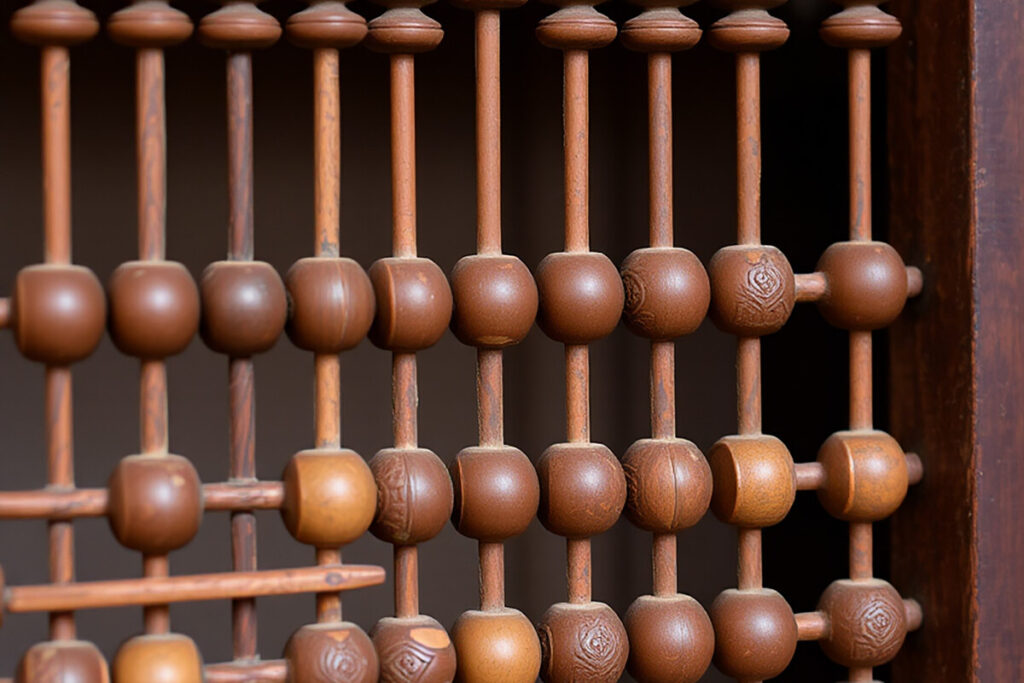
The carrying trick you learned for adding numbers by hand has barely changed in thousands of years of arithmetic.
Arithmetic feels like the most basic part of mathematics, the part everyone masters early and never thinks about again. But some of its oldest tricks are still exactly the ones used in classrooms today, and some of its simplest ideas hide surprisingly modern traps.
A calculation trick with an ancient pedigree
Add 59 and 27 by hand, and the classic method with carrying works like this: nine plus seven equals sixteen, so write down six and carry the one, then five plus two plus one equals eight, giving a final answer of 86. It is a technique that has been taught essentially unchanged for generations, a small piece of ancient practice still living inside everyday math homework.
Arithmetic itself, the branch of mathematics covering addition, subtraction, multiplication and division, gets its name from the Latin arithmetica, itself borrowed from ancient Greek, meaning roughly the art of counting. Egyptian and Sumerian civilizations each independently invented their own number systems around 3000 BCE, long before any of the notation used today existed.
Why one simple triangle proves you need more than whole numbers
Consider a right triangle where both shorter sides measure exactly one unit. Its longest side works out to the square root of two, a number that can never be written exactly as a fraction of two whole numbers. It is a small, almost childishly simple example, and yet it proves irrational numbers are not some exotic mathematical curiosity. They are a practical necessity, forced into existence by a triangle anyone could draw.
The Greeks, active from the 7th and 6th centuries BCE onward, were among the first to study numbers abstractly and to build genuinely rigorous mathematical proofs, moving arithmetic beyond simple counting and into formal reasoning.
The shortcut that turns 64 steps into seven
Raising a number to a large power might seem to demand a long chain of repeated multiplication. Calculating 3 to the 65th power the naive way would require 64 separate multiplications. Using a technique called repeated squaring, the same result can be reached in only seven steps, a shortcut still used inside modern computer processors every time they perform fast calculations.
The measurement mistake with its own name
Not every arithmetic error involves getting a wrong answer. Reporting someone’s height as 1.6217 meters when it was actually measured to the nearest centimeter, as 1.62 meters, is a mistake too, one with a specific name: false precision. Adding invented decimal places does not make a measurement more accurate. It just disguises how uncertain the number really is.
It is easy to assume arithmetic only deals with positive whole numbers, but the field actually spans integers, rational numbers, real numbers, and at times even complex numbers, a far larger territory than simple counting. Even a number like one third, written as 0.333 repeating forever, remains a perfectly valid rational number despite its endless decimal expansion.
From a carrying trick passed down since antiquity to a shortcut hiding inside every modern processor, arithmetic keeps turning out to be far less simple, and far more enduring, than its reputation as the easy branch of math would suggest.