Multiplying two huge numbers by hand could eat an entire afternoon. Then, in 1614, a Scottish mathematician published a book that turned the job into a simple addition, and scientists kept using his trick for more than three and a half centuries.
The problem nobody wanted to do by hand
Picture an astronomer, a navigator or an engineer in the early 1600s. Their work depends on multiplying and dividing long, ugly numbers, over and over, with nothing but ink and paper.
Every calculation is slow. Every step is a chance to make a mistake. And one wrong digit can ruin weeks of work.
The obvious fix would be a faster way to multiply. The actual fix was stranger: stop multiplying altogether.
The idea that turned multiplication into addition
That idea is the logarithm. A logarithm answers one simple question: how many times do you have to multiply a fixed number, called the base, by itself to reach a target?
Take base 10. Multiplying 10 by itself three times gives exactly 1,000, so the logarithm of 1,000 is 3. In other words, a logarithm is just the exponent hiding behind a number, which is why mathematicians describe it as the reverse of raising to a power.
Here is the magic part. The logarithm of two numbers multiplied together equals the sum of their separate logarithms. So instead of multiplying two monsters, you look up their logarithms in a table, add them, then look up which number matches the result. A brutal multiplication becomes a quick addition.
A Scottish book and an English table
The man behind this shortcut was John Napier (1550-1617). In 1614 he published Mirifici Logarithmorum Canonis Descriptio, the founding text that officially introduced the method, designed to make long and tedious calculations radically simpler.
He was not alone in the race. Around 1600, the Swiss mathematician Jost Bürgi had developed similar techniques based on tables of progressions, but he did not publish in time to claim the credit.
Napier’s idea became truly practical thanks to the English mathematician Henry Briggs (1561-1630). In 1617 he compiled the first table of logarithms in base 10, and scientists and navigators could put the method to work immediately.
The impact was enormous. The French scientist Pierre-Simon Laplace later described logarithms as “an admirable artifice which, by reducing to a few days the labour of many months, doubles the life of the astronomer”.
No, logarithms are not a modern invention
Because they show up in calculators and computer science, many people assume logarithms appeared in the 20th century along with scientific computing. The reality is the opposite. They were published in 1614 and adopted very quickly by navigators, scientists and engineers throughout the 17th century.
The ideas kept growing after Napier. Gottfried Wilhelm Leibniz adopted and popularized the notation “Log” in 1675. In 1714, Roger Cotes found a link between logarithms, complex numbers and trigonometry for the first time. In the 18th century, Leonhard Euler formally tied logarithms to the exponential function and made the constant e, about 2.718, their natural base.
Even geometry got involved. The Belgian Jesuit Grégoire de Saint-Vincent (1584-1667) discovered that the area under a hyperbola is deeply connected to natural logarithms, an unexpected bridge between shapes and calculation.
The slide rule and the atomic bomb
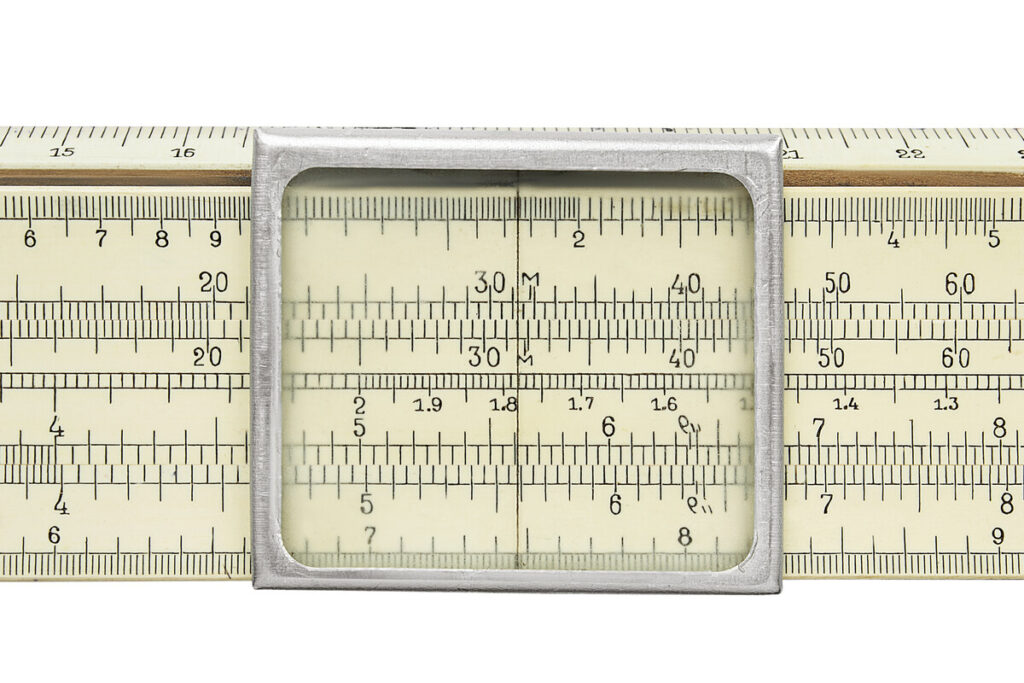
The most famous heir of Napier’s trick was the slide rule. This tool is built entirely on the fact that logarithms turn multiplication into addition: slide one scale along another and you are, in effect, adding logarithms. Engineers considered slide rules indispensable right up to the 1970s, when electronic calculators finally replaced them for good.
Logarithms also caught the attention of Richard Feynman. While working on the Manhattan Project at Los Alamos, the physicist invented his own bit-by-bit algorithm to compute logarithms quickly by hand.
Small numbers, negative answers and computers
Logarithms hold a few surprises of their own. They can be negative: in base 2, the logarithm of one half is exactly minus 1, because you have to divide by 2 once to get there.
That base 2 version, the binary logarithm, is heavily used in computer science. Base 10 remains the common logarithm, and base e gives the natural logarithm, one of the most important tools in calculus.
Even the vocabulary has moved on. The old word “antilogarithm” is now obsolete in modern mathematics, where people simply speak of the exponential function.
A shortcut that outlived its purpose
Nobody needs a logarithm table to multiply anymore. Yet the idea Napier published in 1614 still sits at the heart of calculus and computer science. It is a reminder that the most powerful inventions in mathematics are sometimes not new answers, but clever ways to avoid asking the hard question in the first place.