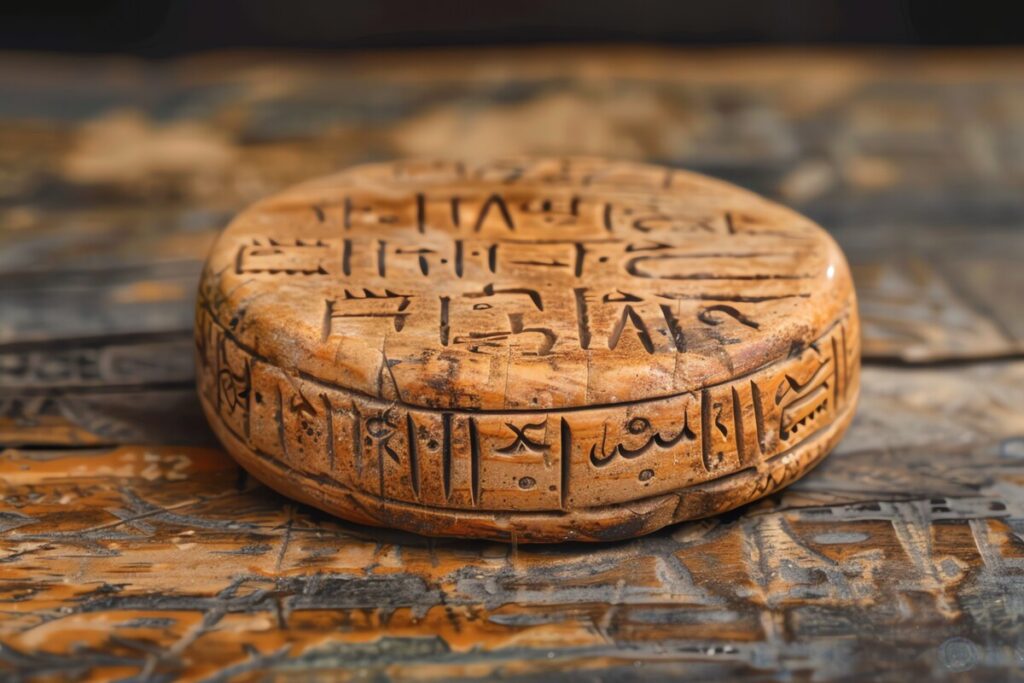
Babylonian scribes were solving quadratic equations nearly 4,000 years ago, and their method still works exactly the same way today.
Long before anyone wrote a single letter of algebra, clay tablets from ancient Mesopotamia already carried the logic behind one of the most famous formulas in mathematics. The scribes who pressed those wedges into wet clay were not just curious. They needed to solve real problems about the areas and sides of rectangular fields, and they built a step by step method to do it.
A five step trick that predates algebra itself
The Babylonian approach worked like this: take half of a coefficient, square it, subtract another term, find the square root using a reference table, then add the pieces back together. Follow those five steps and you land on exactly the same answer the modern quadratic formula gives.
What makes this remarkable is that the Babylonians had no algebraic notation at all. There was no x, no equals sign, no symbols for squaring or square roots. Everything lived in the steps of a procedure, repeated on tablet after tablet, refined by trial and generations of practice.
The formula everyone recognizes came together over centuries
The Egyptians were working on related problems around the same era, and by roughly 300 BCE the Greek mathematician Euclid had built a more abstract, geometric way of finding these same solutions. It took until 628 CE for the Indian mathematician Brahmagupta to write down the first explicit solution to a general quadratic equation.
Centuries later, in the 9th century, the Baghdad scholar al-Khwarizmi went further still, working out solutions that applied to positive results and backing every step with a geometric proof. A flemish mathematician named Simon Stevin finally produced a formula covering every possible case in 1594, and it was Rene Descartes, in his 1637 book La Geometrie, who wrote the formula in the shape still taught in classrooms today.
Where the equation hides in plain sight
Quadratic equations are not just a school exercise. Anyone who has watched a diver leap off a cliff has watched one play out in real time. The horizontal distance the diver travels changes steadily with time, but the vertical drop, shaped by gravity, follows the exact curve a quadratic equation describes.
Even the golden ratio, the famous proportion associated with beauty and balance in nature, turns out to be nothing more exotic than the positive solution to one particularly simple quadratic equation.
The formula everyone learns can still trip up a computer
There is a catch that surprises even people comfortable with the formula. When the two solutions of an equation differ wildly in size, plugging numbers directly into the standard formula on a computer can produce a serious loss of precision. Mathematicians get around this by switching to an alternative version of the same formula, one built specifically to avoid that kind of rounding error.
It is a strange twist for a method with such ancient roots. A calculation first worked out on wet clay in Mesopotamia still needs careful handling to run reliably inside modern computer hardware, proof that even the oldest ideas in mathematics keep finding new ways to matter.