
Around 1550 BC, an Egyptian scribe copied a puzzle about seven houses, each with seven cats, and it reads a lot like a nursery rhyme still sung today.
A scroll bought in a Luxor market
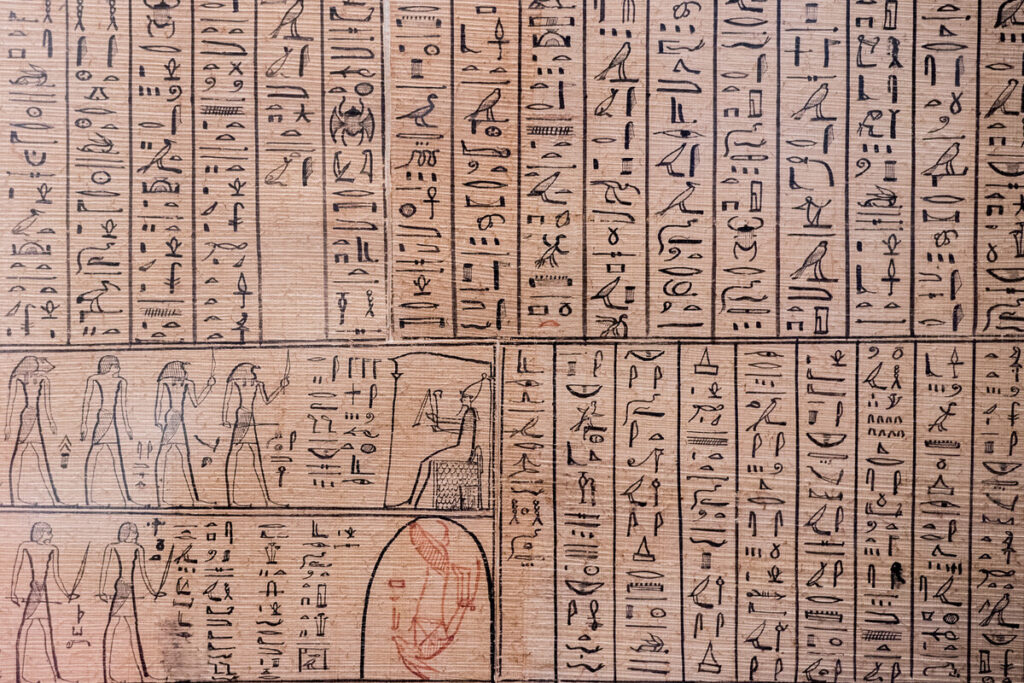
The Rhind Mathematical Papyrus is one of the best known examples of ancient Egyptian mathematics. It takes its name from Alexander Henry Rhind, a Scottish antiquarian who purchased two parts of it in Luxor in 1858. It was said to have been found in one of the small buildings near the Ramesseum.
The British Museum acquired most of it in 1865. Fragments bought separately by the American Egyptologist Edwin Smith were donated in 1906 to the New York Historical Society and now sit in the Brooklyn Museum. An 18 cm section in the middle is missing.
The scribe was copying, not inventing
The papyrus is signed. A scribe named Ahmes (also written Ahmose) states that he copied it “from an ancient copy” made in the time of King Amenemhat III, centuries earlier.
So the math on this scroll was already old when Ahmes picked up his pen. His opening pitch is ambitious: “Accurate reckoning for inquiring into things, and the knowledge of all things, mysteries … all secrets.”
Seven houses, seven cats
Deep in the third part of the scroll sits problem 79, and it is the strangest one. In plain words, it lists seven houses, 49 cats, 343 mice, 2,401 ears of spelt and 16,807 hekats of grain.
Each house holds seven cats. Each cat eats seven mice. Each mouse would have eaten seven ears of grain, and each ear would have produced seven measures of grain. Every step multiplies by seven, and the task is to add up all five numbers. Do it yourself and you get 19,607.
Wikipedia describes the wording as strongly suggestive of the riddle and nursery rhyme “As I was going to St Ives”, the one with the man, the wives, the sacks and the cats. Nobody can prove a direct line from Egypt to England. But the pattern of sevens multiplying again and again is unmistakable.
Bread, beer and fractions
Problem 79 is not typical. The scroll holds 91 problems, and most are practical. The first problems divide loaves of bread among 10 men. Others deal with the strength of bread and beer, or the feed needed for fowl and oxen.
Before the problems comes a long table. For every odd number from 3 to 101, it shows how to write “2 divided by that number” as a sum of fractions with 1 on top. Two fifteenths, for example, becomes one tenth plus one thirtieth.
Close enough to build a pyramid
The geometry section is just as hands-on. To find the area of a circle, the scribes compared it with its circumscribing square, with a ratio of 64 to 81. That quietly treats pi as about 3.16, off by less than one percent.
The last six problems are about pyramids. They ask for the seked, the run of the sloping face for each unit of rise. Given a pyramid 250 cubits high and 360 cubits across its base, the answer comes from half the base divided by the height.
A war note on the back
The back of the scroll carries something that has nothing to do with math. A short note records that “he of the South” broke into the fortress of Tjaru. Egyptologists connect it to the Theban king Ahmose I, whose forces were pushing out the Hyksos rulers.
Scholars think the note was added after the math was finished. A calculation manual ended up holding a scrap of national history, which helps historians place the scroll in time.
What a cat riddle tells us
People have always liked playing with numbers that snowball. A scribe 3,500 years ago apparently saw the fun in it too. The next time you hear that math began as dry bookkeeping, remember the cats.